
Sign In Start Free Trial
Account

Add to playlist

Create a Playlist

Modal Close icon
You need to login to use this feature.
  • Book Overview & Buying Hands-On Design Patterns with C++
  • Table Of Contents Toc
Hands-On Design Patterns with C++

Hands-On Design Patterns with C++

By : Fedor G. Pikus
4.2 (20)
close
close
Hands-On Design Patterns with C++

Hands-On Design Patterns with C++

4.2 (20)
By: Fedor G. Pikus

Overview of this book

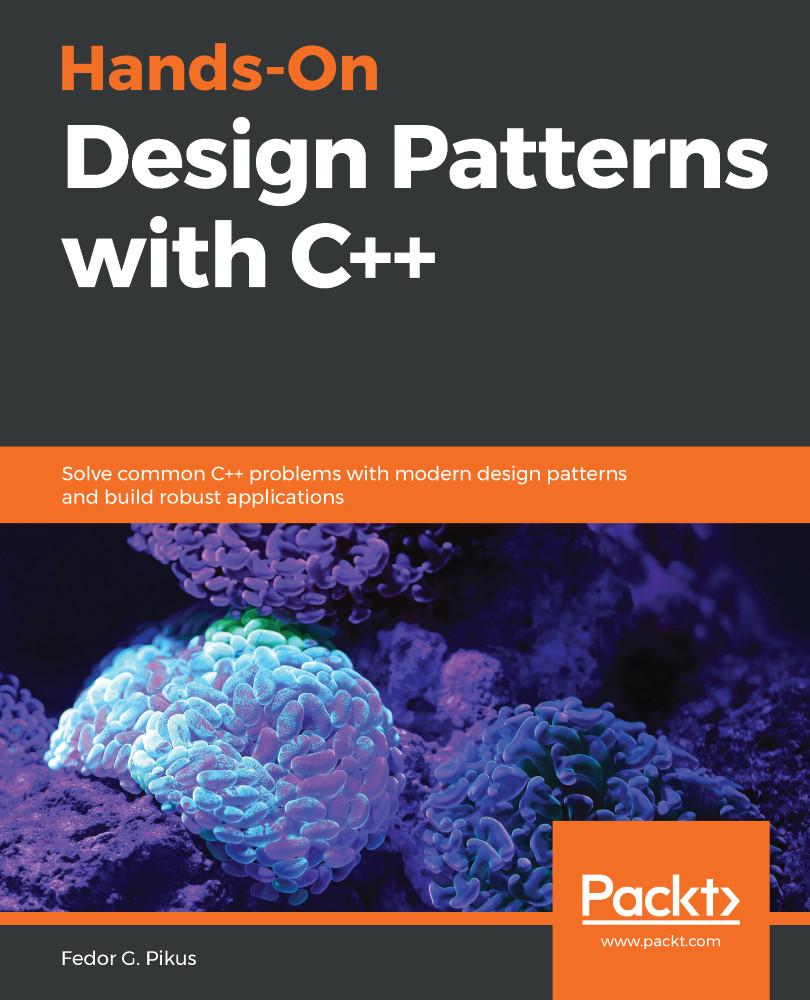
C++ is a general-purpose programming language designed with the goals of efficiency, performance, and flexibility in mind. Design patterns are commonly accepted solutions to well-recognized design problems. In essence, they are a library of reusable components, only for software architecture, and not for a concrete implementation. The focus of this book is on the design patterns that naturally lend themselves to the needs of a C++ programmer, and on the patterns that uniquely benefit from the features of C++, in particular, the generic programming. Armed with the knowledge of these patterns, you will spend less time searching for a solution to a common problem and be familiar with the solutions developed from experience, as well as their advantages and drawbacks. The other use of design patterns is as a concise and an efficient way to communicate. A pattern is a familiar and instantly recognizable solution to specific problem; through its use, sometimes with a single line of code, we can convey a considerable amount of information. The code conveys: "This is the problem we are facing, these are additional considerations that are most important in our case; hence, the following well-known solution was chosen." By the end of this book, you will have gained a comprehensive understanding of design patterns to create robust, reusable, and maintainable code.
Table of Contents (21 chapters)
close
close

Memory Ownership

Memory mismanagement is one of the most common problems in C++ programs. Many of these problems boil down to incorrect assumptions about which part of the code or which entity owns a particular memory. Then, we get memory leaks, accessing unallocated memory, excessive memory use, and other problems that are difficult to debug. Modern C++ has a set of memory ownership idioms that, taken together, allow the programmer to clearly express their design intent when it comes to memory ownership. This, in turn, makes it much easier to write code that correctly allocates, accesses, and deallocates memory.

The following topics are covered in this chapter:

  • What is memory ownership?
  • What are the characteristics of well-designed resource ownership?
  • When and how should we be agnostic about resource ownership?
  • How do we express exclusive memory ownership in C++?
  • How do we express...
Visually different images
CONTINUE READING
83
Tech Concepts
36
Programming languages
73
Tech Tools
Icon Unlimited access to the largest independent learning library in tech of over 8,000 expert-authored tech books and videos.
Icon Innovative learning tools, including AI book assistants, code context explainers, and text-to-speech.
Icon 50+ new titles added per month and exclusive early access to books as they are being written.
Hands-On Design Patterns with C++
notes
bookmark Notes and Bookmarks search Search in title playlist Add to playlist download Download options font-size Font size

Change the font size

margin-width Margin width

Change margin width

day-mode Day/Sepia/Night Modes

Change background colour

Close icon Search
Country selected

Close icon Your notes and bookmarks

Confirmation

Modal Close icon
claim successful

Buy this book with your credits?

Modal Close icon
Are you sure you want to buy this book with one of your credits?
Close
YES, BUY

Submit Your Feedback

Modal Close icon
Modal Close icon
Modal Close icon
