Sign In Start Free Trial
Account

Add to playlist

Create a Playlist

Modal Close icon
You need to login to use this feature.
  • Book Overview & Buying Learn Java 12 Programming
  • Table Of Contents Toc
Learn Java 12 Programming

Learn Java 12 Programming

By : Nick Samoylov
3.7 (6)
close
close
Learn Java 12 Programming

Learn Java 12 Programming

3.7 (6)
By: Nick Samoylov

Overview of this book

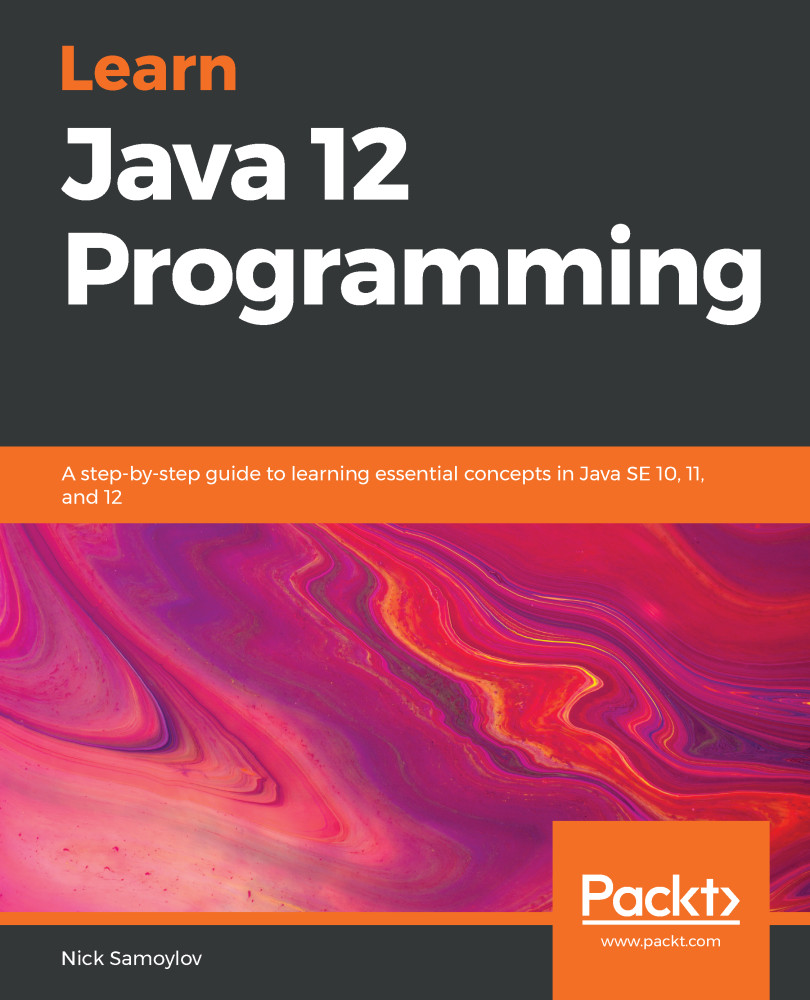
Java is one of the preferred languages among developers, used in everything right from smartphones, and game consoles to even supercomputers, and its new features simply add to the richness of the language. This book on Java programming begins by helping you learn how to install the Java Development Kit. You will then focus on understanding object-oriented programming (OOP), with exclusive insights into concepts like abstraction, encapsulation, inheritance, and polymorphism, which will help you when programming for real-world apps. Next, you’ll cover fundamental programming structures of Java such as data structures and algorithms that will serve as the building blocks for your apps. You will also delve into core programming topics that will assist you with error handling, debugging, and testing your apps. As you progress, you’ll move on to advanced topics such as Java libraries, database management, and network programming, which will hone your skills in building professional-grade apps. Further on, you’ll understand how to create a graphic user interface using JavaFX and learn to build scalable apps by taking advantage of reactive and functional programming. By the end of this book, you’ll not only be well versed with Java 10, 11, and 12, but also gain a perspective into the future of this language and software development in general.

Table of Contents (25 chapters)
close
close
Lock Free Chapter
1
Section 1: Overview of Java Programming
5
Section 2: Building Blocks of Java
15
Section 3: Advanced Java

Quiz

    1. Select all of the correct statements:
      1. An IDE executes Java code without compiling it.
      2. An IDE uses the installed Java to execute the code.
      3. An IDE checks the code without using the Java installation.
      4. An IDE uses the compiler of the Java installation.
    1. Select all of the correct statements:
      1. All the classes used by the application have to be listed on the classpath.
      2. The locations of all the classes used by the application have to be listed on the classpath.
      3. The compiler can find a class if it is in the folder listed on the classpath.
      4. Classes of the main package do not need to be listed on the classpath.
    1. Select all of the correct statements:
      1. All the .jar files used by the application have to be listed on the classpath.
      2. The locations of all the .jar files used by the application have to be listed on the classpath.
      3. The JVM can find a class only if it is in the .jar...
    CONTINUE READING
    83
    Tech Concepts
    36
    Programming languages
    73
    Tech Tools
    Icon Unlimited access to the largest independent learning library in tech of over 8,000 expert-authored tech books and videos.
    Icon Innovative learning tools, including AI book assistants, code context explainers, and text-to-speech.
    Icon 50+ new titles added per month and exclusive early access to books as they are being written.
    Learn Java 12 Programming
    notes
    bookmark Notes and Bookmarks search Search in title playlist Add to playlist download Download options font-size Font size

    Change the font size

    margin-width Margin width

    Change margin width

    day-mode Day/Sepia/Night Modes

    Change background colour

    Close icon Search
    Country selected

    Close icon Your notes and bookmarks

    Confirmation

    Modal Close icon
    claim successful

    Buy this book with your credits?

    Modal Close icon
    Are you sure you want to buy this book with one of your credits?
    Close
    YES, BUY

    Submit Your Feedback

    Modal Close icon
    Modal Close icon
    Modal Close icon