Sign In Start Free Trial
Account

Add to playlist

Create a Playlist

Modal Close icon
You need to login to use this feature.
  • Book Overview & Buying Mastering Go
  • Table Of Contents Toc
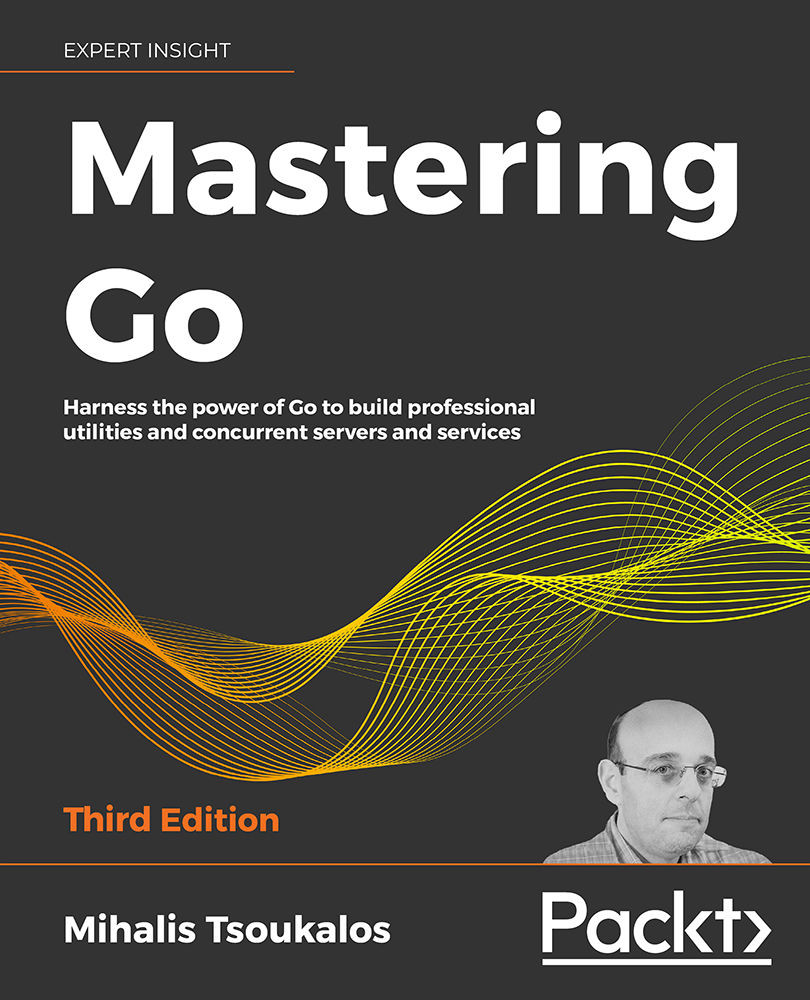
Mastering Go

Mastering Go - Third Edition

By : Mihalis Tsoukalos
4.6 (16)
close
close
Mastering Go

Mastering Go

4.6 (16)
By: Mihalis Tsoukalos

Overview of this book

Mastering Go is the essential guide to putting Go to work on real production systems. This freshly updated third edition includes topics like creating RESTful servers and clients, understanding Go generics, and developing gRPC servers and clients. Mastering Go was written for programmers who want to explore the capabilities of Go in practice. As you work your way through the chapters, you’ll gain confidence and a deep understanding of advanced Go concepts, including concurrency and the operation of the Go Garbage Collector, using Go with Docker, writing powerful command-line utilities, working with JavaScript Object Notation (JSON) data, and interacting with databases. You’ll also improve your understanding of Go internals to optimize Go code and use data types and data structures in new and unexpected ways. This essential Go programming book will also take you through the nuances and idioms of Go with exercises and resources to fully embed your newly acquired knowledge. With the help of Mastering Go, you’ll become an expert Go programmer by building Go systems and implementing advanced Go techniques in your projects.
Table of Contents (17 chapters)
close
close
14
Other Books You May Enjoy
15
Index

Using go:generate

Although go:generate is not directly connected to testing or profiling, it is a handy and advanced Go feature and I believe that this chapter is the perfect place for discussing it as it can also help you with testing. The go:generate directive is associated with the go generate command, was added in Go 1.4 in order to help with automation, and allows you to run commands described by directives within existing files.

The go generate command supports the -v, -n, and -x flags. The -v flag prints the names of packages and files as they are processed whereas the -n flag prints the commands that would be executed. Last, the -x flag prints commands as they are executed—this is great for debugging go:generate commands.

The main reasons that you might need to use go:generate are the following:

  • You want to download dynamic data from the Internet or some other source prior to the execution of the Go code.
  • You want to execute some code prior...
CONTINUE READING
83
Tech Concepts
36
Programming languages
73
Tech Tools
Icon Unlimited access to the largest independent learning library in tech of over 8,000 expert-authored tech books and videos.
Icon Innovative learning tools, including AI book assistants, code context explainers, and text-to-speech.
Icon 50+ new titles added per month and exclusive early access to books as they are being written.
Mastering Go
notes
bookmark Notes and Bookmarks search Search in title playlist Add to playlist download Download options font-size Font size

Change the font size

margin-width Margin width

Change margin width

day-mode Day/Sepia/Night Modes

Change background colour

Close icon Search
Country selected

Close icon Your notes and bookmarks

Confirmation

Modal Close icon
claim successful

Buy this book with your credits?

Modal Close icon
Are you sure you want to buy this book with one of your credits?
Close
YES, BUY

Submit Your Feedback

Modal Close icon
Modal Close icon
Modal Close icon