Sign In Start Free Trial
Account

Add to playlist

Create a Playlist

Modal Close icon
You need to login to use this feature.
  • Book Overview & Buying Modern C++ Programming Cookbook
  • Table Of Contents Toc
Modern C++ Programming Cookbook

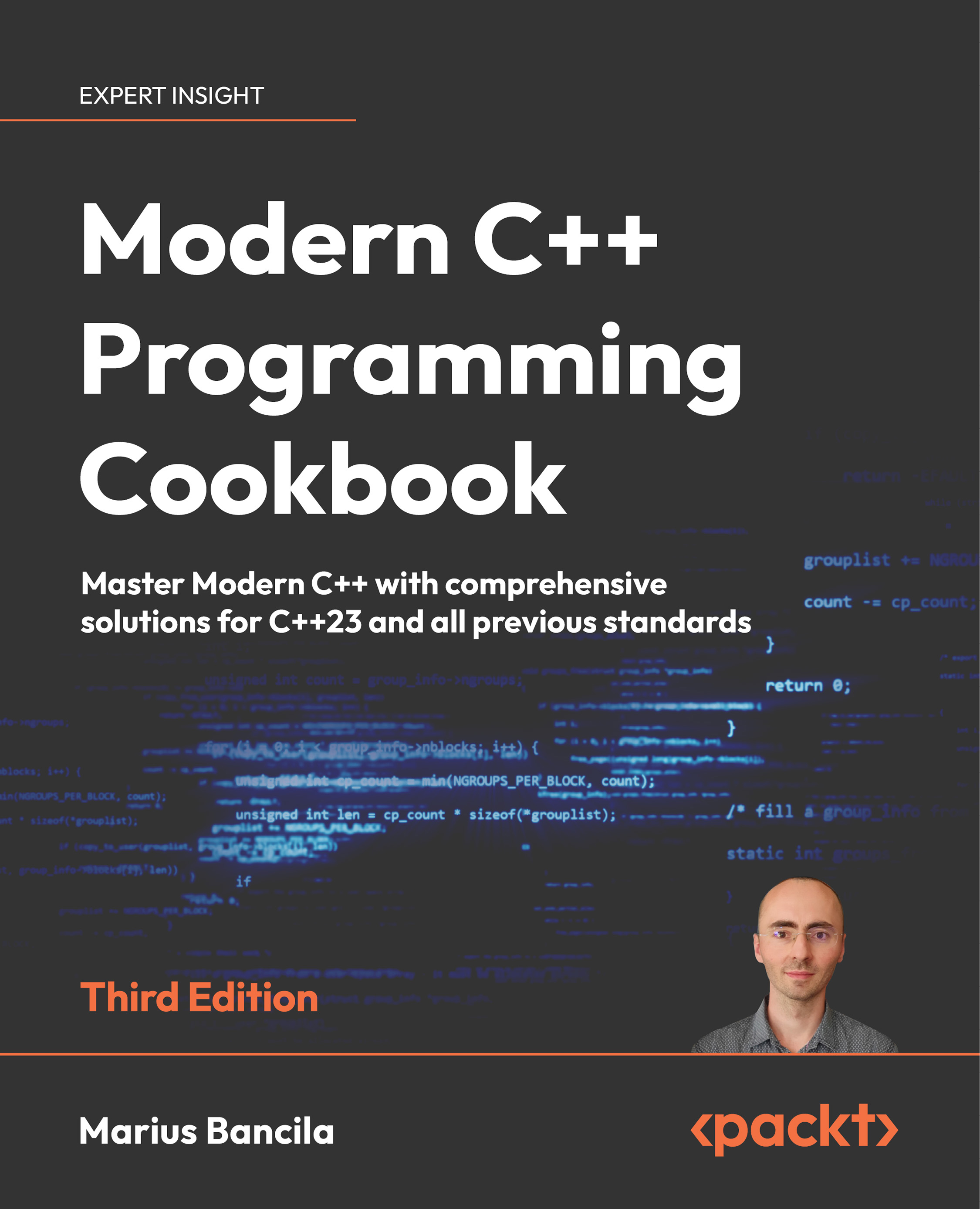
Modern C++ Programming Cookbook - Third Edition

By : Marius Bancila
4.6 (21)
close
close
Modern C++ Programming Cookbook

Modern C++ Programming Cookbook

4.6 (21)
By: Marius Bancila

Overview of this book

The updated third edition of Modern C++ Programming Cookbook addresses the latest features of C++23, such as the stacktrace library, std::expected and std::mdspan classes, the header, formatting library improvements, and updates to the ranges library. It also gets into more C++20 topics not previously covered, such as sync streams and source_location. The book is organized into practical recipes covering a wide range of real-world problems, helping you find the solutions you need quickly. You’ll find coverage of all the core concepts of modern C++ programming and features and techniques from C++11 through to C++23, meaning you’ll stay ahead of the curve by learning to incorporate the newest language and library improvements. Beyond the core concepts and new features, you’ll explore recipes related to performance and best practices, how to implement useful patterns and idioms, like pimpl, named parameter, attorney-client, and the factory pattern, and how to complete unit testing with the widely used C++ libraries: Boost.Test, Google Test, and Catch2. With the comprehensive coverage this C++ programming guide offers, by the end of the book you’ll have everything you need to build performant, scalable, and efficient applications in C++.
Table of Contents (15 chapters)
close
close
13
Other Books You May Enjoy
14
Index

Preface

C++ is one of the most popular and widely used programming languages, and it has been that way for three decades. Designed with a focus on performance, efficiency, and flexibility, C++ combines paradigms such as object-oriented, imperative, generic, and functional programming. C++ is standardized by the International Organization for Standardization (ISO) and has undergone massive changes over the last decade and a half. With the standardization of C++11, the language has entered a new age, which has been widely referred to as modern C++. Type inference, move semantics, lambda expressions, smart pointers, uniform initialization, variadic templates, and many other recent features have changed the way we write code in C++ to the point that it almost looks like a new programming language. This change has been further advanced with the release of C++20, which includes many new changes to the language, such as modules, concepts, and coroutines, as well as changes to the standard library, such as ranges, text formatting, and calendars. And now, the language is moving even further with more changes introduced in C++23 and the upcoming C++26.

This book addresses many of the new features included in C++11, C++14, C++17, C++20, and C++23. This book is organized into recipes, each covering one particular language or library feature, or a common problem that developers often face and the typical solution to it using modern C++. Through more than 150 recipes, you will learn to master both core language features and the standard libraries; including those for strings, containers, algorithms, iterators, streams, regular expressions, threads, filesystem, atomic operations, utilities, and ranges.

This third edition of the book took several months to write, and during this time the work on the C++23 standard has been completed. However, at the time of writing this preface, the standard is yet to be approved and will be published this year (2024).

More than 30 new or updated recipes in the second and third editions cover C++20 features, including modules, concepts, coroutines, ranges, threads and synchronization mechanisms, text formatting, calendars and time zones, immediate functions, the three-way comparison operator, and the new std::span class. Almost 20 new or updated recipes in this third edition cover C++23 features, including the std::expected class, the std::mdspan class, the stacktrace library, the span buffer, the multi-dimensional subscript operator, and the additions to the text format library.

All the recipes in the book contain code samples that show you how to use a feature or how to solve a problem. These code samples have been written using Visual Studio 2022, but have also been compiled using Clang and GCC. Since the support for various language and library features has been gradually added to all these compilers, it is recommended that you use the latest version of each to ensure that all of the new features are supported.

At the time of writing this preface, the latest versions are GCC 14.0, Clang 18.0, and VC++ 2022 version 14.37 (from Visual Studio 2019 version 17.7). Although all these compilers are C++17 complete, the support for C++23 varies from compiler to compiler. Please refer to https://en.cppreference.com/w/cpp/compiler_support to check your compiler’s support for C++23 features.

CONTINUE READING
83
Tech Concepts
36
Programming languages
73
Tech Tools
Icon Unlimited access to the largest independent learning library in tech of over 8,000 expert-authored tech books and videos.
Icon Innovative learning tools, including AI book assistants, code context explainers, and text-to-speech.
Icon 50+ new titles added per month and exclusive early access to books as they are being written.
Modern C++ Programming Cookbook
notes
bookmark Notes and Bookmarks search Search in title playlist Add to playlist download Download options font-size Font size

Change the font size

margin-width Margin width

Change margin width

day-mode Day/Sepia/Night Modes

Change background colour

Close icon Search
Country selected

Close icon Your notes and bookmarks

Confirmation

Modal Close icon
claim successful

Buy this book with your credits?

Modal Close icon
Are you sure you want to buy this book with one of your credits?
Close
YES, BUY

Submit Your Feedback

Modal Close icon
Modal Close icon
Modal Close icon