
Sign In Start Free Trial
Account

Add to playlist

Create a Playlist

Modal Close icon
You need to login to use this feature.
  • Book Overview & Buying Expert C++
  • Table Of Contents Toc
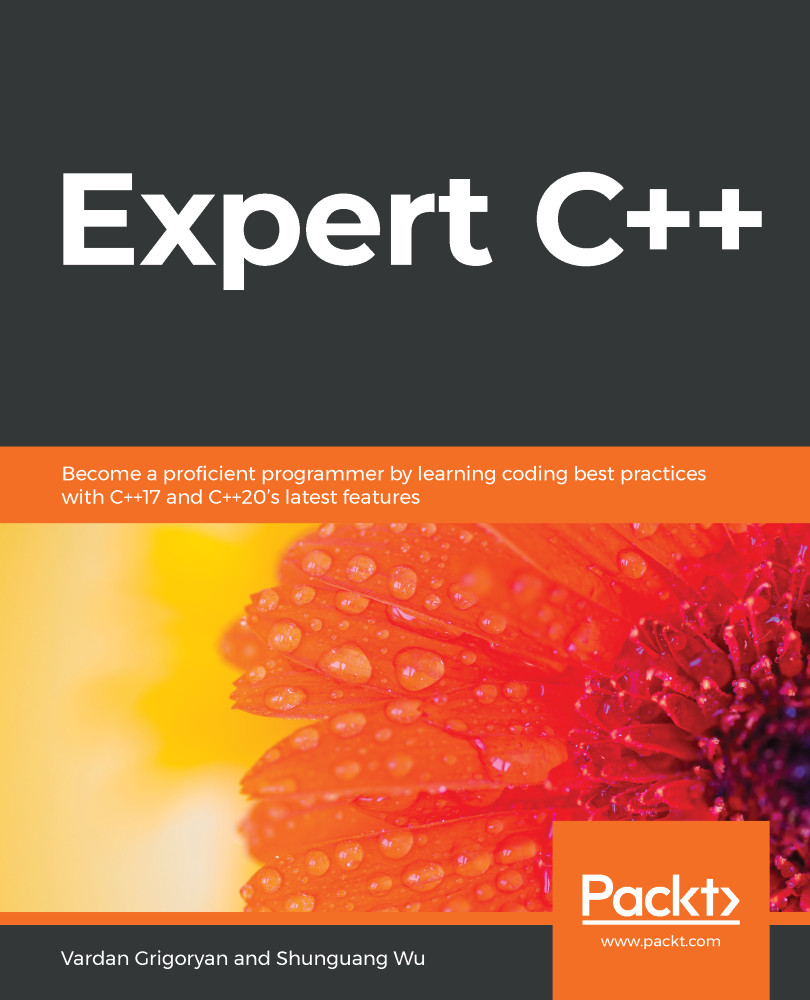
Expert C++

Expert C++

By : Vardan Grigoryan, Shunguang Wu
3.1 (9)
close
close
Expert C++

Expert C++

3.1 (9)
By: Vardan Grigoryan, Shunguang Wu

Overview of this book

C++ has evolved over the years and the latest release – C++20 – is now available. Since C++11, C++ has been constantly enhancing the language feature set. With the new version, you’ll explore an array of features such as concepts, modules, ranges, and coroutines. This book will be your guide to learning the intricacies of the language, techniques, C++ tools, and the new features introduced in C++20, while also helping you apply these when building modern and resilient software. You’ll start by exploring the latest features of C++, and then move on to advanced techniques such as multithreading, concurrency, debugging, monitoring, and high-performance programming. The book will delve into object-oriented programming principles and the C++ Standard Template Library, and even show you how to create custom templates. After this, you’ll learn about different approaches such as test-driven development (TDD), behavior-driven development (BDD), and domain-driven design (DDD), before taking a look at the coding best practices and design patterns essential for building professional-grade applications. Toward the end of the book, you will gain useful insights into the recent C++ advancements in AI and machine learning. By the end of this C++ programming book, you’ll have gained expertise in real-world application development, including the process of designing complex software.
Table of Contents (22 chapters)
close
close
1
Section 1: Under the Hood of C++ Programming
7
Section 2: Designing Robust and Efficient Applications
17
Section 3: C++ in the AI World

Designing Concurrent Data Structures

In the previous chapter, we touched on the basics of concurrency and multithreading in C++. One of the biggest challenges in concurrent code design is properly handling data races. Thread synchronization and orchestration is not an easy topic to grasp, although we might consider it the most important one. While we can use synchronization primitives such as mutexes everywhere that we have the slightest doubt about a data race, it's not a best practice that we would advise.

A better way of designing concurrent code is to avoid locks at all costs. That would not only increase the performance of the application but also make it much safer than before. Easier said than done – lock-free programming is a challenging topic that we are introducing in this chapter. In particular, we will go further into the fundamentals of designing lock...

Visually different images
CONTINUE READING
83
Tech Concepts
36
Programming languages
73
Tech Tools
Icon Unlimited access to the largest independent learning library in tech of over 8,000 expert-authored tech books and videos.
Icon Innovative learning tools, including AI book assistants, code context explainers, and text-to-speech.
Icon 50+ new titles added per month and exclusive early access to books as they are being written.
Expert C++
notes
bookmark Notes and Bookmarks search Search in title playlist Add to playlist download Download options font-size Font size

Change the font size

margin-width Margin width

Change margin width

day-mode Day/Sepia/Night Modes

Change background colour

Close icon Search
Country selected

Close icon Your notes and bookmarks

Confirmation

Modal Close icon
claim successful

Buy this book with your credits?

Modal Close icon
Are you sure you want to buy this book with one of your credits?
Close
YES, BUY

Submit Your Feedback

Modal Close icon
Modal Close icon
Modal Close icon