


- Typically, the main() function has two parameters, argc and argv, where argc is the number of input arguments to the program and argv constitutes those input arguments. Very occasionally, you can see a widely supported, but not standardized, third argument, most commonly named envp. The type of envp is an array of char pointers and it holds the environment variables of the system.
- The constexpr specifier declares that the value of the function can be evaluated at compile time. The same definition applies to variables as well. The name consists of const and expressions.
- Recursion leads to the allocation of additional space for function invocations. It is expensive to allocate space for the function and call compared to an iterative solution.
- The stack holds objects with automatic storage duration; that is, programmers do not concern themselves with the construction...
-
Book Overview & Buying
-
Table Of Contents

Expert C++
By :


Expert C++
By:
Overview of this book
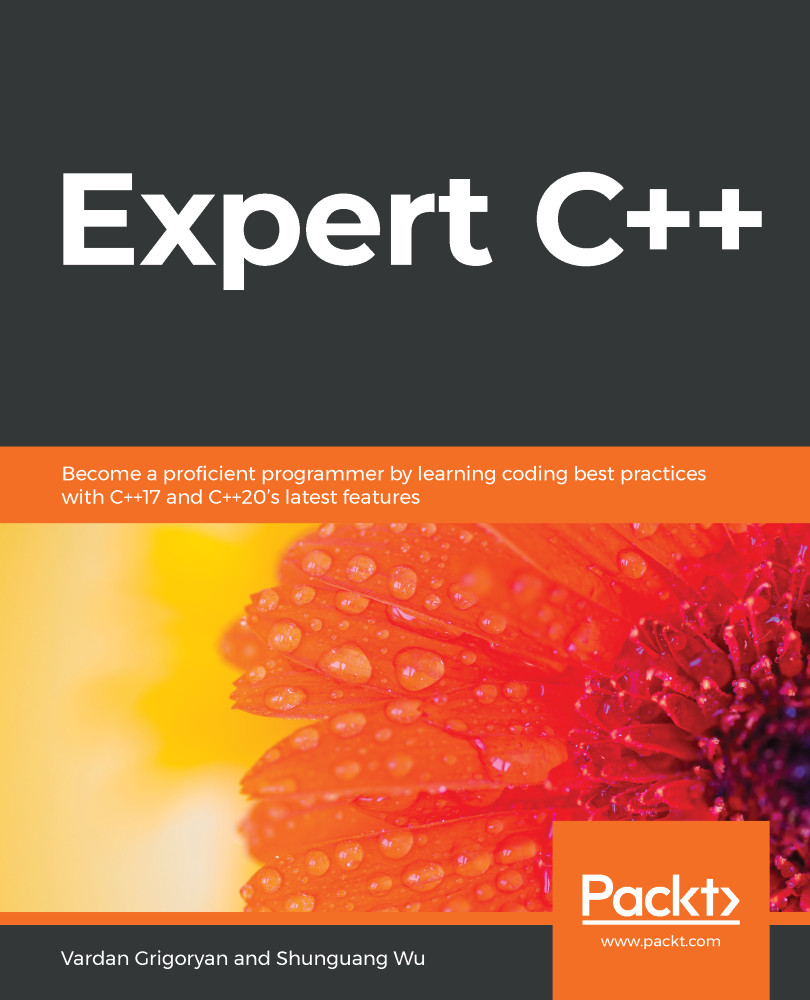
C++ has evolved over the years and the latest release – C++20 – is now available. Since C++11, C++ has been constantly enhancing the language feature set. With the new version, you’ll explore an array of features such as concepts, modules, ranges, and coroutines. This book will be your guide to learning the intricacies of the language, techniques, C++ tools, and the new features introduced in C++20, while also helping you apply these when building modern and resilient software.
You’ll start by exploring the latest features of C++, and then move on to advanced techniques such as multithreading, concurrency, debugging, monitoring, and high-performance programming. The book will delve into object-oriented programming principles and the C++ Standard Template Library, and even show you how to create custom templates. After this, you’ll learn about different approaches such as test-driven development (TDD), behavior-driven development (BDD), and domain-driven design (DDD), before taking a look at the coding best practices and design patterns essential for building professional-grade applications. Toward the end of the book, you will gain useful insights into the recent C++ advancements in AI and machine learning.
By the end of this C++ programming book, you’ll have gained expertise in real-world application development, including the process of designing complex software.
Table of Contents (22 chapters)
Preface

Section 1: Under the Hood of C++ Programming
 Free Chapter
Introduction to Building C++ Applications
Low-Level Programming with C++
Details of Object-Oriented Programming
Understanding and Designing Templates
Memory Management and Smart Pointers
Section 2: Designing Robust and Efficient Applications
Digging into Data Structures and Algorithms in STL
Functional Programming
Concurrency and Multithreading
Designing Concurrent Data Structures
Designing World-Ready Applications
Designing a Strategy Game Using Design Patterns
Networking and Security
Debugging and Testing
Graphical User Interface with Qt
Section 3: C++ in the AI World
Using C++ in Machine Learning Tasks
Implementing a Dialog-Based Search Engine
Assessments

Other Books You May Enjoy


