
Sign In Start Free Trial
Account

Add to playlist

Create a Playlist

Modal Close icon
You need to login to use this feature.
  • Book Overview & Buying Hands-On Q-Learning with Python
  • Table Of Contents Toc
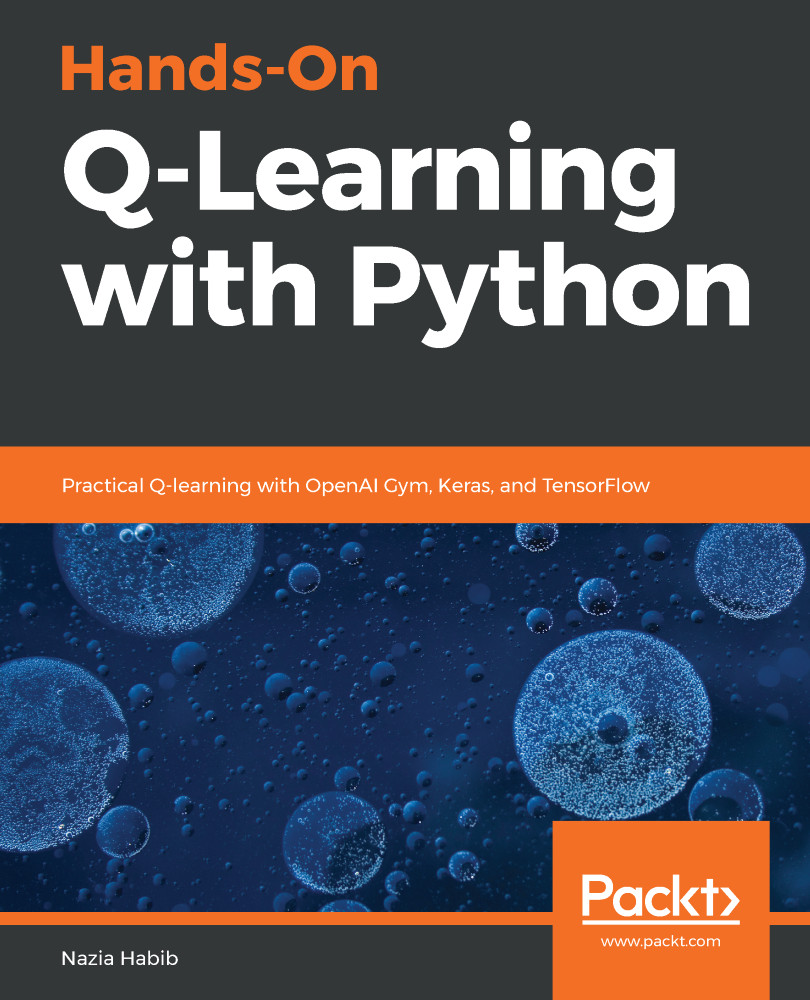
Hands-On Q-Learning with Python

Hands-On Q-Learning with Python

By : Nazia Habib
2.3 (3)
close
close
Hands-On Q-Learning with Python

Hands-On Q-Learning with Python

2.3 (3)
By: Nazia Habib

Overview of this book

Q-learning is a machine learning algorithm used to solve optimization problems in artificial intelligence (AI). It is one of the most popular fields of study among AI researchers. This book starts off by introducing you to reinforcement learning and Q-learning, in addition to helping you become familiar with OpenAI Gym as well as libraries such as Keras and TensorFlow. A few chapters into the book, you will gain insights into model-free Q-learning and use deep Q-networks and double deep Q-networks to solve complex problems. This book will guide you in exploring use cases such as self-driving vehicles and OpenAI Gym’s CartPole problem. You will also learn how to tune and optimize Q-networks and their hyperparameters. As you progress, you will understand the reinforcement learning approach to solving real-world problems. You will also explore how to use Q-learning and related algorithms in scientific research. Toward the end, you’ll gain insight into what’s in store for reinforcement learning. By the end of this book, you will be equipped with the skills you need to solve reinforcement learning problems using Q-learning algorithms with OpenAI Gym, Keras, and TensorFlow.
Table of Contents (14 chapters)
close
close
Lock Free Chapter
1
Section 1: Q-Learning: A Roadmap
6
Section 2: Building and Optimizing Q-Learning Agents
9
Section 3: Advanced Q-Learning Challenges with Keras, TensorFlow, and OpenAI Gym

Brushing Up on Reinforcement Learning Concepts

In this book, you will learn the fundamentals of Q-learning, a branch of reinforcement learning (RL), and how to apply them to challenging real-world optimization problems. You'll design software that dynamically writes itself, modifies itself, and improves its own performance in real time.

In doing so, you will build self-learning intelligent agents that start with no knowledge of how to solve a problem and independently find optimal solutions to that problem through observation, trial and error, and memory.

RL is one of the most exciting branches of artificial intelligence (AI) and powers some of its most visible successes, from recommendation systems that learn from user behavior to game-playing machines that can beat any human being at chess or Go.

Q-learning is one of the easiest versions of RL to get started with, and...

Visually different images
CONTINUE READING
83
Tech Concepts
36
Programming languages
73
Tech Tools
Icon Unlimited access to the largest independent learning library in tech of over 8,000 expert-authored tech books and videos.
Icon Innovative learning tools, including AI book assistants, code context explainers, and text-to-speech.
Icon 50+ new titles added per month and exclusive early access to books as they are being written.
Hands-On Q-Learning with Python
notes
bookmark Notes and Bookmarks search Search in title playlist Add to playlist download Download options font-size Font size

Change the font size

margin-width Margin width

Change margin width

day-mode Day/Sepia/Night Modes

Change background colour

Close icon Search
Country selected

Close icon Your notes and bookmarks

Confirmation

Modal Close icon
claim successful

Buy this book with your credits?

Modal Close icon
Are you sure you want to buy this book with one of your credits?
Close
YES, BUY

Submit Your Feedback

Modal Close icon
Modal Close icon
Modal Close icon