


-
Book Overview & Buying
-
Table Of Contents

Interpretable Machine Learning with Python - Second Edition
By :


Interpretable Machine Learning with Python
By:
Overview of this book
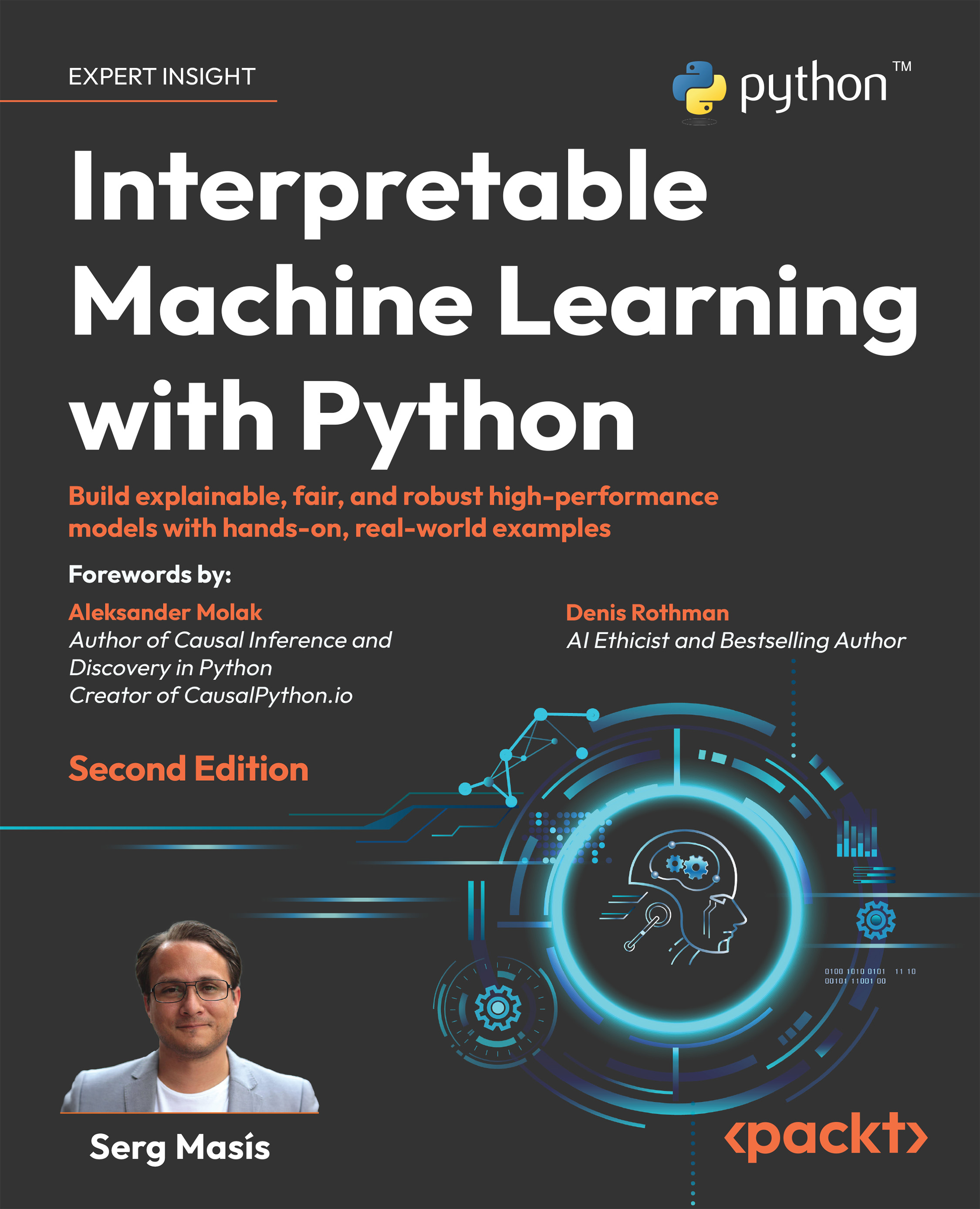
Interpretable Machine Learning with Python, Second Edition, brings to light the key concepts of interpreting machine learning models by analyzing real-world data, providing you with a wide range of skills and tools to decipher the results of even the most complex models.
Build your interpretability toolkit with several use cases, from flight delay prediction to waste classification to COMPAS risk assessment scores. This book is full of useful techniques, introducing them to the right use case. Learn traditional methods, such as feature importance and partial dependence plots to integrated gradients for NLP interpretations and gradient-based attribution methods, such as saliency maps.
In addition to the step-by-step code, you’ll get hands-on with tuning models and training data for interpretability by reducing complexity, mitigating bias, placing guardrails, and enhancing reliability.
By the end of the book, you’ll be confident in tackling interpretability challenges with black-box models using tabular, language, image, and time series data.
Table of Contents (17 chapters)
Preface


Interpretation, Interpretability, and Explainability; and Why Does It All Matter?
 Free Chapter
Key Concepts of Interpretability
Interpretation Challenges
Global Model-Agnostic Interpretation Methods
Local Model-Agnostic Interpretation Methods
Anchors and Counterfactual Explanations
Visualizing Convolutional Neural Networks
Interpreting NLP Transformers
Interpretation Methods for Multivariate Forecasting and Sensitivity Analysis
Feature Selection and Engineering for Interpretability

Bias Mitigation and Causal Inference Methods
Monotonic Constraints and Model Tuning for Interpretability
Adversarial Robustness
What’s Next for Machine Learning Interpretability?
Other Books You May Enjoy
Index


