Sign In Start Free Trial
Account

Add to playlist

Create a Playlist

Modal Close icon
You need to login to use this feature.
  • Book Overview & Buying Introducing Microsoft SQL Server 2019
  • Table Of Contents Toc
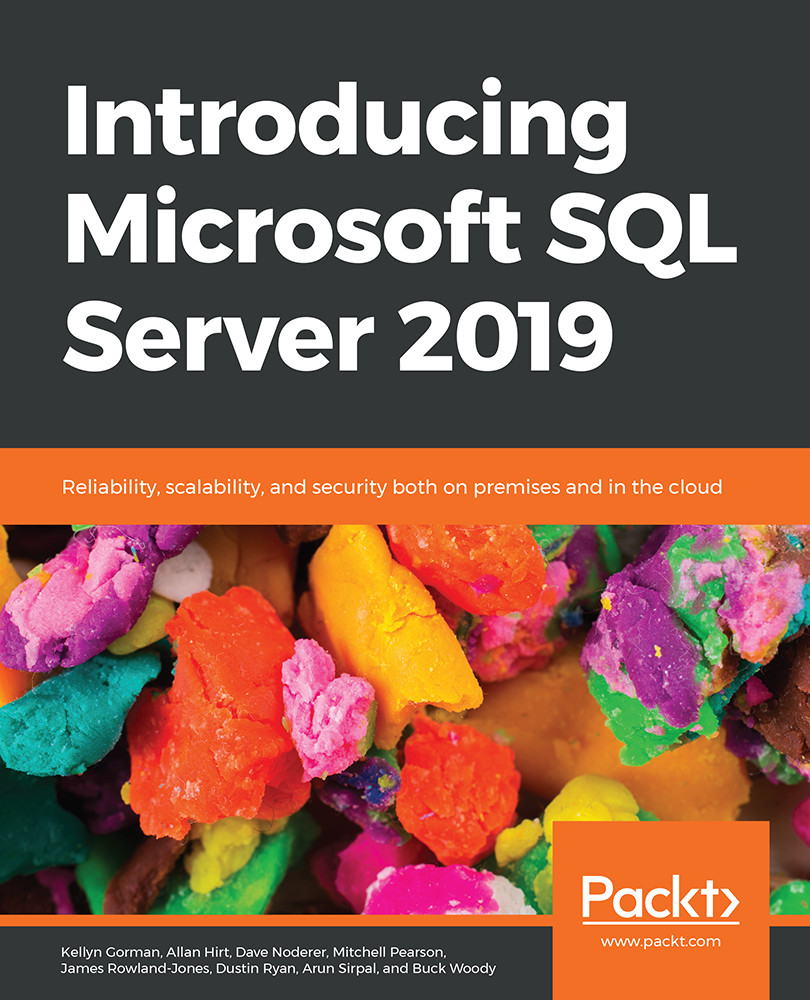
Introducing Microsoft SQL Server 2019

Introducing Microsoft SQL Server 2019

By : Kellyn Gorman , Allan Hirt , Dave Noderer , Mitchell Pearson , James Rowland-Jones , Dustin Ryan , Arun Sirpal , Buck Woody
close
close
Introducing Microsoft SQL Server 2019

Introducing Microsoft SQL Server 2019

By: Kellyn Gorman , Allan Hirt , Dave Noderer , Mitchell Pearson , James Rowland-Jones , Dustin Ryan , Arun Sirpal , Buck Woody

Overview of this book

Microsoft SQL Server comes equipped with industry-leading features and the best online transaction processing capabilities. If you are looking to work with data processing and management, getting up to speed with Microsoft Server 2019 is key. Introducing SQL Server 2019 takes you through the latest features in SQL Server 2019 and their importance. You will learn to unlock faster querying speeds and understand how to leverage the new and improved security features to build robust data management solutions. Further chapters will assist you with integrating, managing, and analyzing all data, including relational, NoSQL, and unstructured big data using SQL Server 2019. Dedicated sections in the book will also demonstrate how you can use SQL Server 2019 to leverage data processing platforms, such as Apache Hadoop and Spark, and containerization technologies like Docker and Kubernetes to control your data and efficiently monitor it. By the end of this book, you'll be well versed with all the features of Microsoft SQL Server 2019 and understand how to use them confidently to build robust data management solutions.
Table of Contents (15 chapters)
close
close

Machine learning using the PREDICT T-SQL command

Once you have created a model (also called a "trained model"), you can save it in a binary format for "scoring" the results of a prediction. Both R and Python have methods to store the trained models as binary outputs. It's common to store these models in the database itself, which then allows you to process requests from clients in a T-SQL statement and return the results as a dataset. This process requires the runtime (R or Python) to process the request.

As an example, if you were to create the k-means clustering solution around the customer returns mentioned earlier, you could save that model as a binary object, perhaps even from another server that holds the customer data. You could then deploy that model to a server located at each store and run it using the PREDICT statement to alert the salespeople to the behavior that might lead to a return, thereby preventing customer dissatisfaction.

Functions...

Visually different images
CONTINUE READING
83
Tech Concepts
36
Programming languages
73
Tech Tools
Icon Unlimited access to the largest independent learning library in tech of over 8,000 expert-authored tech books and videos.
Icon Innovative learning tools, including AI book assistants, code context explainers, and text-to-speech.
Icon 50+ new titles added per month and exclusive early access to books as they are being written.
Introducing Microsoft SQL Server 2019
notes
bookmark Notes and Bookmarks search Search in title playlist Add to playlist download Download options font-size Font size

Change the font size

margin-width Margin width

Change margin width

day-mode Day/Sepia/Night Modes

Change background colour

Close icon Search
Country selected

Close icon Your notes and bookmarks

Confirmation

Modal Close icon
claim successful

Buy this book with your credits?

Modal Close icon
Are you sure you want to buy this book with one of your credits?
Close
YES, BUY

Submit Your Feedback

Modal Close icon
Modal Close icon
Modal Close icon