Sign In Start Free Trial
Account

Add to playlist

Create a Playlist

Modal Close icon
You need to login to use this feature.
  • Book Overview & Buying Learning Object-Oriented Programming
  • Table Of Contents Toc
  • Feedback & Rating feedback
Learning Object-Oriented Programming

Learning Object-Oriented Programming

By : Gaston C. Hillar
3.3 (3)
close
close
Learning Object-Oriented Programming

Learning Object-Oriented Programming

3.3 (3)
By: Gaston C. Hillar

Overview of this book

If you're a Python, JavaScript, or C# developer and want to learn the basics of object-oriented programming with real-world examples, then this book is for you.
Table of Contents (10 chapters)
close
close
9
Index

Recognizing objects from nouns

Let's imagine, we have to develop a new simple application, and we receive a description with the requirements. The application must allow users to calculate the areas and perimeters of squares, rectangles, circles, and ellipses.

It is indeed a very simple application, and you can start writing code in Python, JavaScript, and C#. You can create four functions that calculate the areas of the shapes mentioned earlier. Moreover, you can create four additional functions that calculate the perimeters for them. For example, the following seven functions would do the job:

  • calculateSquareArea: This receives the parameters of the square and returns the value of the calculated area for the shape
  • calculateRectangleArea: This receives the parameters of the rectangle and returns the value of the calculated area for the shape
  • calculateCircleArea: This receives the parameters of the circle and returns the value of the calculated area for the shape
  • calculateEllipseArea: This receives the parameters of the ellipse and returns the value of the calculated area for the shape
  • calculateSquarePerimeter: This receives the parameters of the square and returns the value of the calculated perimeter for the shape
  • calculateRectanglePerimeter: This receives the parameters of the rectangle and returns the value of the calculated perimeter for the shape
  • calculateCirclePerimeter: This receives the parameters of the circle and returns the value of the calculated perimeter for the shape

However, let's forget a bit about programming languages and functions. Let's recognize the real-world objects from the application's requirements. It is necessary to calculate the areas and perimeters of four elements, that is, four nouns in the requirements that represent real-life objects:

  • Square
  • Rectangle
  • Circle
  • Ellipse

We can design our application by following an object-oriented paradigm. Instead of creating a set of functions that perform the required tasks, we can create software objects that represent the state and behavior of a square, rectangle, circle, and an ellipse. This way, the different objects mimic the real-world shapes. We can work with the objects to specify the different attributes required to calculate their areas and their perimeters.

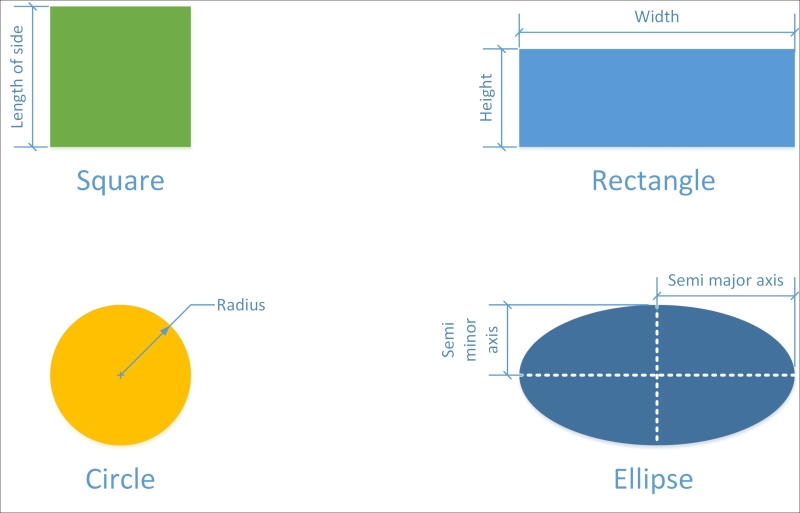
Now, let's move to the real world and think about the four shapes. Imagine that you have to draw the four shapes on paper and calculate both their areas and perimeters. What information do you require for each of the shapes? Think about this, and then, take a look at the following table that summarizes the data required for each shape:

Shape

Required data

Square

Length of side

Rectangle

Width and height

Circle

Radius (usually labeled as r)

Ellipse

Semi-major axis (usually labeled as a) and semi-minor axis (usually labeled as b)

Tip

The data required by each of the shapes is going to be encapsulated in each object. For example, the object that represents a rectangle encapsulates both the rectangle's width and height. Data encapsulation is one of the major pillars of object-oriented programming.

The following diagram shows the four shapes drawn and their elements:

Recognizing objects from nouns
Visually different images
CONTINUE READING
83
Tech Concepts
36
Programming languages
73
Tech Tools
Icon Unlimited access to the largest independent learning library in tech of over 8,000 expert-authored tech books and videos.
Icon Innovative learning tools, including AI book assistants, code context explainers, and text-to-speech.
Icon 50+ new titles added per month and exclusive early access to books as they are being written.
Learning Object-Oriented Programming
notes
bookmark Notes and Bookmarks search Search in title playlist Add to playlist font-size Font size

Change the font size

margin-width Margin width

Change margin width

day-mode Day/Sepia/Night Modes

Change background colour

Close icon Search
Country selected

Close icon Your notes and bookmarks

Confirmation

Modal Close icon
claim successful

Buy this book with your credits?

Modal Close icon
Are you sure you want to buy this book with one of your credits?
Close
YES, BUY

Submit Your Feedback

Modal Close icon
Modal Close icon
Modal Close icon