Sign In Start Free Trial
Account

Add to playlist

Create a Playlist

Modal Close icon
You need to login to use this feature.
  • Book Overview & Buying Learning Object-Oriented Programming
  • Table Of Contents Toc
  • Feedback & Rating feedback
Learning Object-Oriented Programming

Learning Object-Oriented Programming

By : Gaston C. Hillar
3.3 (3)
close
close
Learning Object-Oriented Programming

Learning Object-Oriented Programming

3.3 (3)
By: Gaston C. Hillar

Overview of this book

If you're a Python, JavaScript, or C# developer and want to learn the basics of object-oriented programming with real-world examples, then this book is for you.
Table of Contents (10 chapters)
close
close
9
Index

Generating blueprints for objects

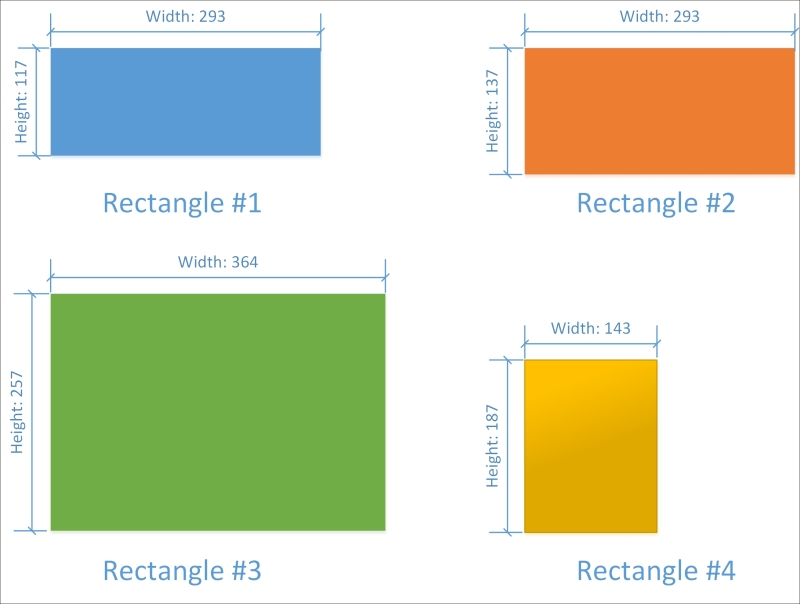
Imagine that you want to draw and calculate the areas of four different rectangles. You will end up with four rectangles drawn, with their different widths, heights, and calculated areas. It would be great to have a blueprint to simplify the process of drawing each rectangle with their different widths and heights.

In object-oriented programming, a class is a blueprint or a template definition from which the objects are created. Classes are models that define the state and behavior of an object. After defining a class that defines the state and behavior of a rectangle, we can use it to generate objects that represent the state and behavior of each real-world rectangle.

Tip

Objects are also known as instances. For example, we can say each rectangle object is an instance of the rectangle class.

The following image shows four rectangle instances drawn, with their widths and heights specified: Rectangle #1, Rectangle #2, Rectangle #3, and Rectangle #4. We can use a rectangle class as a blueprint to generate the four different rectangle instances. It is very important to understand the difference between a class and the objects or instances generated through its usage. Object-oriented programming allows us to discover the blueprint we used to generate a specific object. Thus, we are able to infer that each object is an instance of the rectangle class.

Generating blueprints for objects

We recognized four completely different real-world objects from the application's requirements. We need classes to create the objects, and therefore, we require the following four classes:

  • Square
  • Rectangle
  • Circle
  • Ellipse
Visually different images
CONTINUE READING
83
Tech Concepts
36
Programming languages
73
Tech Tools
Icon Unlimited access to the largest independent learning library in tech of over 8,000 expert-authored tech books and videos.
Icon Innovative learning tools, including AI book assistants, code context explainers, and text-to-speech.
Icon 50+ new titles added per month and exclusive early access to books as they are being written.
Learning Object-Oriented Programming
notes
bookmark Notes and Bookmarks search Search in title playlist Add to playlist font-size Font size

Change the font size

margin-width Margin width

Change margin width

day-mode Day/Sepia/Night Modes

Change background colour

Close icon Search
Country selected

Close icon Your notes and bookmarks

Confirmation

Modal Close icon
claim successful

Buy this book with your credits?

Modal Close icon
Are you sure you want to buy this book with one of your credits?
Close
YES, BUY

Submit Your Feedback

Modal Close icon
Modal Close icon
Modal Close icon