Sign In Start Free Trial
Account

Add to playlist

Create a Playlist

Modal Close icon
You need to login to use this feature.
  • Book Overview & Buying Rust Web Programming
  • Table Of Contents Toc
Rust Web Programming

Rust Web Programming - Second Edition

By : Maxwell Flitton
5 (6)
close
close
Rust Web Programming

Rust Web Programming

5 (6)
By: Maxwell Flitton

Overview of this book

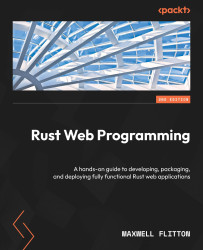
Are safety and high performance a big concern for you while developing web applications? With this practical Rust book, you’ll discover how you can implement Rust on the web to achieve the desired performance and security as you learn techniques and tooling to build fully operational web apps. In this second edition, you’ll get hands-on with implementing emerging Rust web frameworks, including Actix, Rocket, and Hyper. It also features HTTPS configuration on AWS when deploying a web application and introduces you to Terraform for automating the building of web infrastructure on AWS. What’s more, this edition also covers advanced async topics. Built on the Tokio async runtime, this explores TCP and framing, implementing async systems with the actor framework, and queuing tasks on Redis to be consumed by a number of worker nodes. Finally, you’ll go over best practices for packaging Rust servers in distroless Rust Docker images with database drivers, so your servers are a total size of 50Mb each. By the end of this book, you’ll have confidence in your skills to build robust, functional, and scalable web applications from scratch.
Table of Contents (27 chapters)
close
close
Lock Free Chapter
1
Part 1:Getting Started with Rust Web Development
4
Part 2:Processing Data and Managing Displays
8
Part 3:Data Persistence
12
Part 4:Testing and Deployment
16
Part 5:Making Our Projects Flexible
19
Part 6:Exploring Protocol Programming and Async Concepts with Low-Level Network Applications

Building our runner actor

Our runner actor consistently loops, sending messages to the state actor, asking for batched data, and sending the batched data to the server if the batched data is present. This means that our actor will be sending and receiving messages throughout the lifetime of the program. With the behavior of the runner actor in mind, it should not be a shock that we need the following imports in the src/actors/runner.rs file:

use super::messages::{MessageType, StateActorMessage};
use tokio::sync::mpsc::{Sender, Receiver};
use std::time;

We have imported the messages and the modules required to sleep for a period of seconds. We have also used type aliases to define the type of channels our runner actor will be supporting. We can now define the runner actor with the following code:

pub struct RunnerActor {
    pub interval: i32,
    pub receiver: Receiver<StateActorMessage>,
    pub sender: Sender...
CONTINUE READING
83
Tech Concepts
36
Programming languages
73
Tech Tools
Icon Unlimited access to the largest independent learning library in tech of over 8,000 expert-authored tech books and videos.
Icon Innovative learning tools, including AI book assistants, code context explainers, and text-to-speech.
Icon 50+ new titles added per month and exclusive early access to books as they are being written.
Rust Web Programming
notes
bookmark Notes and Bookmarks search Search in title playlist Add to playlist download Download options font-size Font size

Change the font size

margin-width Margin width

Change margin width

day-mode Day/Sepia/Night Modes

Change background colour

Close icon Search
Country selected

Close icon Your notes and bookmarks

Confirmation

Modal Close icon
claim successful

Buy this book with your credits?

Modal Close icon
Are you sure you want to buy this book with one of your credits?
Close
YES, BUY

Submit Your Feedback

Modal Close icon
Modal Close icon
Modal Close icon