
Sign In Start Free Trial
Account

Add to playlist

Create a Playlist

Modal Close icon
You need to login to use this feature.
  • Book Overview & Buying Hands-On Machine Learning with scikit-learn and Scientific Python Toolkits
  • Table Of Contents Toc
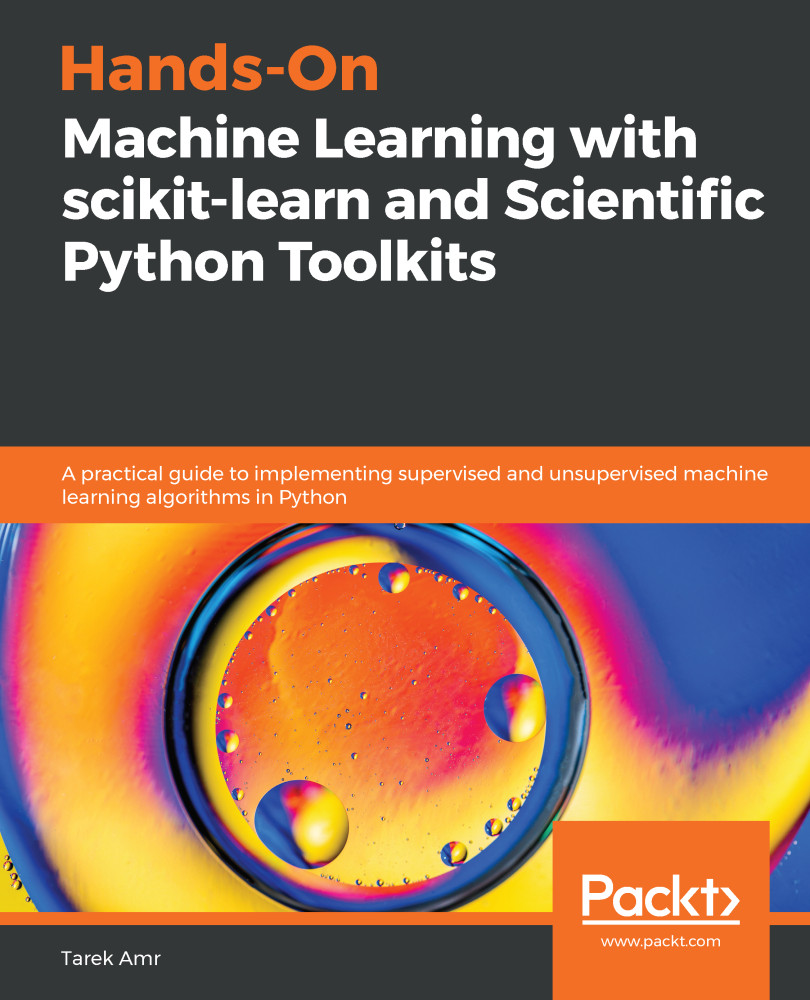
Hands-On Machine Learning with scikit-learn and Scientific Python Toolkits

Hands-On Machine Learning with scikit-learn and Scientific Python Toolkits

By : Tarek Amr
4.8 (4)
close
close
Hands-On Machine Learning with scikit-learn and Scientific Python Toolkits

Hands-On Machine Learning with scikit-learn and Scientific Python Toolkits

4.8 (4)
By: Tarek Amr

Overview of this book

Machine learning is applied everywhere, from business to research and academia, while scikit-learn is a versatile library that is popular among machine learning practitioners. This book serves as a practical guide for anyone looking to provide hands-on machine learning solutions with scikit-learn and Python toolkits. The book begins with an explanation of machine learning concepts and fundamentals, and strikes a balance between theoretical concepts and their applications. Each chapter covers a different set of algorithms, and shows you how to use them to solve real-life problems. You’ll also learn about various key supervised and unsupervised machine learning algorithms using practical examples. Whether it is an instance-based learning algorithm, Bayesian estimation, a deep neural network, a tree-based ensemble, or a recommendation system, you’ll gain a thorough understanding of its theory and learn when to apply it. As you advance, you’ll learn how to deal with unlabeled data and when to use different clustering and anomaly detection algorithms. By the end of this machine learning book, you’ll have learned how to take a data-driven approach to provide end-to-end machine learning solutions. You’ll also have discovered how to formulate the problem at hand, prepare required data, and evaluate and deploy models in production.
Table of Contents (18 chapters)
close
close
1
Section 1: Supervised Learning
8
Section 2: Advanced Supervised Learning
13
Section 3: Unsupervised Learning and More

Using baseline algorithms

The simplicity of the nearest neighbors algorithm is a double-edged sword. On the one hand, it is easier to grasp, but on the other hand, it lacks an objective function that we can optimize during training. This also means that the majority of its computation is performed during prediction time. To overcome these problems, Yehuda Koren formulated the recommendation problem in terms of an optimization task. Still, for each user-item pair, we need to estimate a rating (ru,i). The expected rating this time is the summation of the following triplet:

  • : The overall average rating given by all users to all items
  • bu: A term for how the user (u) deviates from the overall average rating
  • bi: A term for how the item (i) deviates from the average rating

Here is the formula for the expected ratings:

For each user-item pair in our training set, we know its actual rating (ru...

Visually different images
CONTINUE READING
83
Tech Concepts
36
Programming languages
73
Tech Tools
Icon Unlimited access to the largest independent learning library in tech of over 8,000 expert-authored tech books and videos.
Icon Innovative learning tools, including AI book assistants, code context explainers, and text-to-speech.
Icon 50+ new titles added per month and exclusive early access to books as they are being written.
Hands-On Machine Learning with scikit-learn and Scientific Python Toolkits
notes
bookmark Notes and Bookmarks search Search in title playlist Add to playlist download Download options font-size Font size

Change the font size

margin-width Margin width

Change margin width

day-mode Day/Sepia/Night Modes

Change background colour

Close icon Search
Country selected

Close icon Your notes and bookmarks

Confirmation

Modal Close icon
claim successful

Buy this book with your credits?

Modal Close icon
Are you sure you want to buy this book with one of your credits?
Close
YES, BUY

Submit Your Feedback

Modal Close icon
Modal Close icon
Modal Close icon