
Sign In Start Free Trial
Account

Add to playlist

Create a Playlist

Modal Close icon
You need to login to use this feature.
  • Book Overview & Buying Java Programming for Beginners
  • Table Of Contents Toc
  • Feedback & Rating feedback
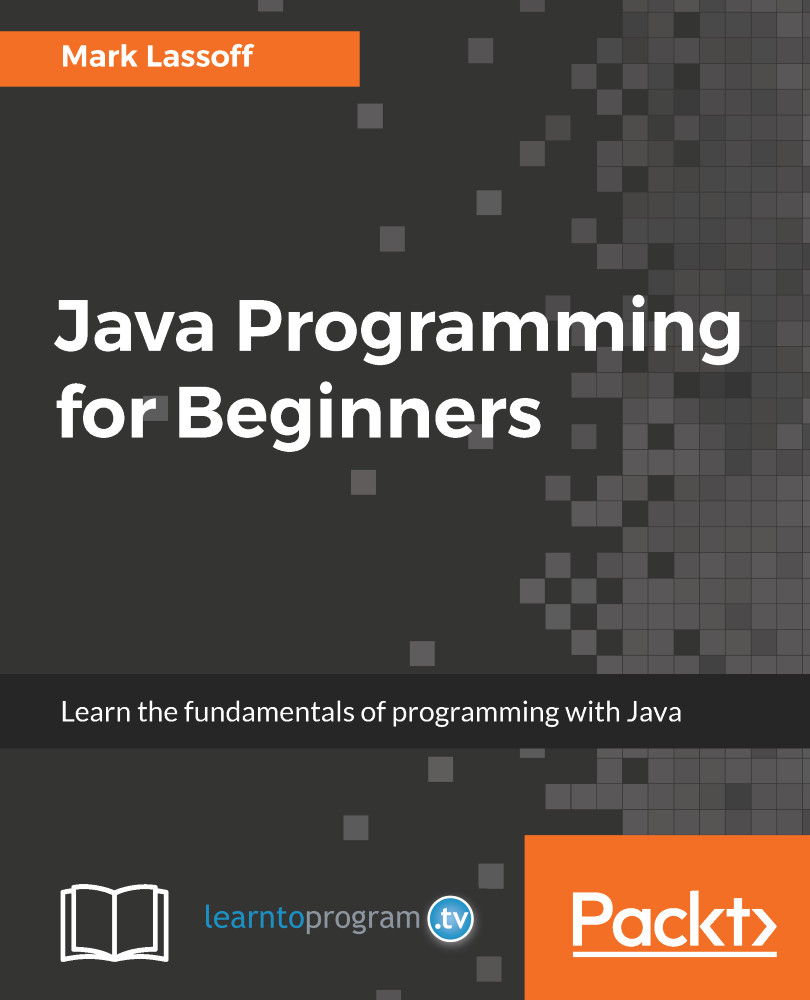
Java Programming for Beginners

Java Programming for Beginners

By : SkillSprints Inc., Mark Lassoff
3.8 (8)
close
close
Java Programming for Beginners

Java Programming for Beginners

3.8 (8)
By: SkillSprints Inc., Mark Lassoff

Overview of this book

Java is an object-oriented programming language, and is one of the most widely accepted languages because of its design and programming features, particularly in its promise that you can write a program once and run it anywhere. Java Programming for Beginners is an excellent introduction to the world of Java programming, taking you through the basics of Java syntax and the complexities of object-oriented programming. You'll gain a full understanding of Java SE programming and will be able to write Java programs with graphical user interfaces that run on PC, Mac, or Linux machines. This book is full of informative and entertaining content, challenging exercises, and dozens of code examples you can run and learn from. By reading this book, you’ll move from understanding the data types in Java, through loops and conditionals, and on to functions, classes, and file handling. The book finishes with a look at GUI development and training on how to work with XML. The book takes an efficient route through the Java landscape, covering all of the core topics that a Java developer needs. Whether you’re an absolute beginner to programming, or a seasoned programmer approaching an object-oriented language for the first time, Java Programming for Beginners delivers the focused training you need to become a Java developer.
Table of Contents (12 chapters)
close
close

Advanced Java functions

In this section, I'd like you to take a deeper look into Java methods and also learn some really valuable things about how programming languages think about and manipulate information. To help us do this, I'd like to run an experiment of sorts, and to start that experiment off, I've written a really basic Java program:

package advancedmethods; 
 
public class AdvancedMethods { 
    public static void main(String[] args) { 
        int x = 5; 
        magic(x); 
        System.out.println("main: " + x); 
    } 
    public static void magic(int input) 
    { 
        input += 10; 
    } 
} 

At the core of this Java program is the magic method, which is user-defined following the main method. When we come across a new Java method, there's three real things we should notice about it:

  1. First, we should ask, "what are its input...
Visually different images
CONTINUE READING
83
Tech Concepts
36
Programming languages
73
Tech Tools
Icon Unlimited access to the largest independent learning library in tech of over 8,000 expert-authored tech books and videos.
Icon Innovative learning tools, including AI book assistants, code context explainers, and text-to-speech.
Icon 50+ new titles added per month and exclusive early access to books as they are being written.
Java Programming for Beginners
notes
bookmark Notes and Bookmarks search Search in title playlist Add to playlist download Download options font-size Font size

Change the font size

margin-width Margin width

Change margin width

day-mode Day/Sepia/Night Modes

Change background colour

Close icon Search
Country selected

Close icon Your notes and bookmarks

Confirmation

Modal Close icon
claim successful

Buy this book with your credits?

Modal Close icon
Are you sure you want to buy this book with one of your credits?
Close
YES, BUY

Submit Your Feedback

Modal Close icon
Modal Close icon
Modal Close icon