Sign In Start Free Trial
Account

Add to playlist

Create a Playlist

Modal Close icon
You need to login to use this feature.
  • Book Overview & Buying Learn Python Programming
  • Table Of Contents Toc
Learn Python Programming

Learn Python Programming - Third Edition

By : Fabrizio Romano, Heinrich Kruger
4.2 (35)
close
close
Learn Python Programming

Learn Python Programming

4.2 (35)
By: Fabrizio Romano, Heinrich Kruger

Overview of this book

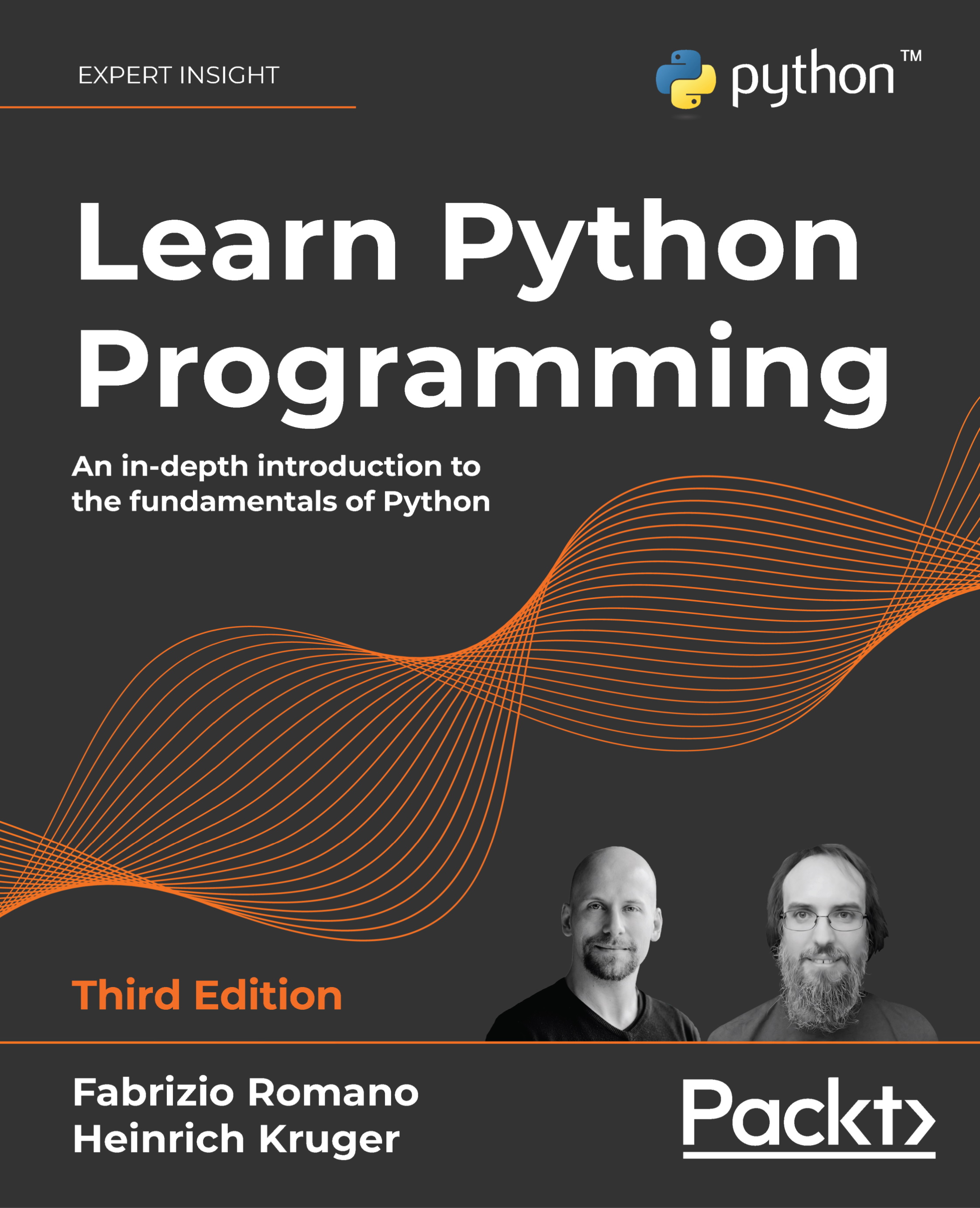
Learn Python Programming, Third Edition is both a theoretical and practical introduction to Python, an extremely flexible and powerful programming language that can be applied to many disciplines. This book will make learning Python easy and give you a thorough understanding of the language. You'll learn how to write programs, build modern APIs, and work with data by using renowned Python data science libraries. This revised edition covers the latest updates on API management, packaging applications, and testing. There is also broader coverage of context managers and an updated data science chapter. The book empowers you to take ownership of writing your software and become independent in fetching the resources you need. You will have a clear idea of where to go and how to build on what you have learned from the book. Through examples, the book explores a wide range of applications and concludes by building real-world Python projects based on the concepts you have learned.
Table of Contents (18 chapters)
close
close
16
Other Books You May Enjoy
17
Index

Summary

In this chapter, we started to explore the world of programming and that of Python. We've barely scratched the surface, only touching upon concepts that will be discussed later on in the book in greater detail.

We talked about Python's main features, who is using it and for what, and the different ways in which we can write a Python program.

In the last part of the chapter, we flew over the fundamental notions of namespaces, scopes, classes, and objects. We also saw how Python code can be organized using modules and packages.

On a practical level, we learned how to install Python on our system, how to make sure we have the tools we need, such as pip, and we also created and activated our first virtual environment. This will allow us to work in a self-contained environment without the risk of compromising the Python system installation.

Now you're ready to start this journey with us. All you need is enthusiasm, an activated virtual environment...

CONTINUE READING
83
Tech Concepts
36
Programming languages
73
Tech Tools
Icon Unlimited access to the largest independent learning library in tech of over 8,000 expert-authored tech books and videos.
Icon Innovative learning tools, including AI book assistants, code context explainers, and text-to-speech.
Icon 50+ new titles added per month and exclusive early access to books as they are being written.
Learn Python Programming
notes
bookmark Notes and Bookmarks search Search in title playlist Add to playlist download Download options font-size Font size

Change the font size

margin-width Margin width

Change margin width

day-mode Day/Sepia/Night Modes

Change background colour

Close icon Search
Country selected

Close icon Your notes and bookmarks

Confirmation

Modal Close icon
claim successful

Buy this book with your credits?

Modal Close icon
Are you sure you want to buy this book with one of your credits?
Close
YES, BUY

Submit Your Feedback

Modal Close icon
Modal Close icon
Modal Close icon