Sign In Start Free Trial
Account

Add to playlist

Create a Playlist

Modal Close icon
You need to login to use this feature.
  • Book Overview & Buying Learn Python Programming
  • Table Of Contents Toc
Learn Python Programming

Learn Python Programming - Third Edition

By : Fabrizio Romano, Heinrich Kruger
4.2 (35)
close
close
Learn Python Programming

Learn Python Programming

4.2 (35)
By: Fabrizio Romano, Heinrich Kruger

Overview of this book

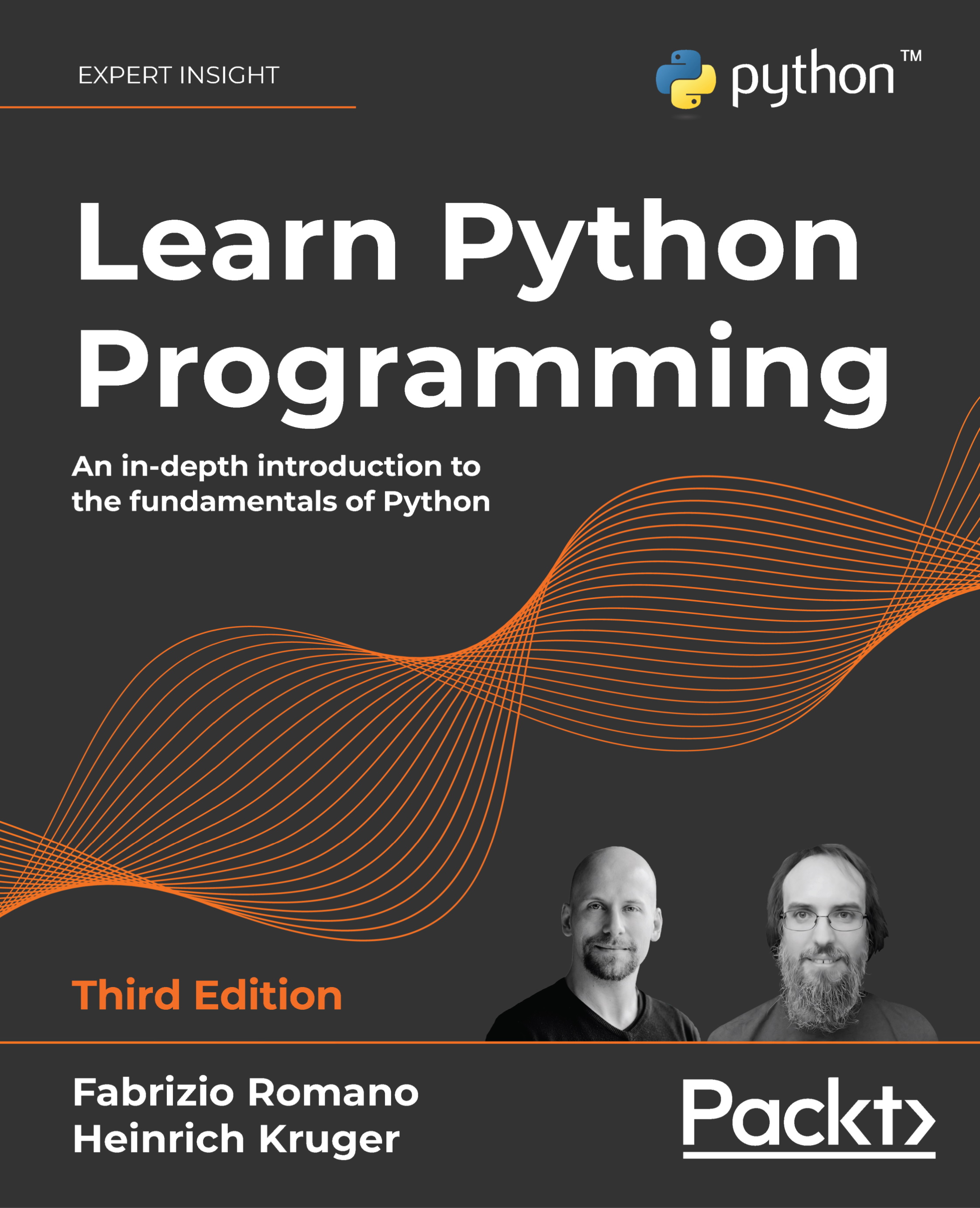
Learn Python Programming, Third Edition is both a theoretical and practical introduction to Python, an extremely flexible and powerful programming language that can be applied to many disciplines. This book will make learning Python easy and give you a thorough understanding of the language. You'll learn how to write programs, build modern APIs, and work with data by using renowned Python data science libraries. This revised edition covers the latest updates on API management, packaging applications, and testing. There is also broader coverage of context managers and an updated data science chapter. The book empowers you to take ownership of writing your software and become independent in fetching the resources you need. You will have a clear idea of where to go and how to build on what you have learned from the book. Through examples, the book explores a wide range of applications and concludes by building real-world Python projects based on the concepts you have learned.
Table of Contents (18 chapters)
close
close
16
Other Books You May Enjoy
17
Index

Dealing with data

Typically, when you deal with data, this is the path you go through: you fetch it; you clean and manipulate it; and then you analyze it and present results as values, spreadsheets, graphs, and so on. We want you to be in charge of all three steps of the process without having any external dependency on a data provider, so we're going to do the following:

  1. We're going to create the data, simulating that it comes in a format that is not perfect or ready to be worked on.
  2. We're going to clean it and feed it to the main tool we'll use in the project, which is a DataFrame from the pandas library.
  3. We're going to manipulate the data in a DataFrame.
  4. We're going to save a DataFrame to a file in different formats.
  5. We're going to analyze the data and get some results out of it.

Setting up the Notebook

First things first, let's produce the data. We start from the ch13-dataprep Notebook. Cell...

CONTINUE READING
83
Tech Concepts
36
Programming languages
73
Tech Tools
Icon Unlimited access to the largest independent learning library in tech of over 8,000 expert-authored tech books and videos.
Icon Innovative learning tools, including AI book assistants, code context explainers, and text-to-speech.
Icon 50+ new titles added per month and exclusive early access to books as they are being written.
Learn Python Programming
notes
bookmark Notes and Bookmarks search Search in title playlist Add to playlist download Download options font-size Font size

Change the font size

margin-width Margin width

Change margin width

day-mode Day/Sepia/Night Modes

Change background colour

Close icon Search
Country selected

Close icon Your notes and bookmarks

Confirmation

Modal Close icon
claim successful

Buy this book with your credits?

Modal Close icon
Are you sure you want to buy this book with one of your credits?
Close
YES, BUY

Submit Your Feedback

Modal Close icon
Modal Close icon
Modal Close icon