
Sign In Start Free Trial
Account

Add to playlist

Create a Playlist

Modal Close icon
You need to login to use this feature.
  • Book Overview & Buying Hands-On Mathematics for Deep Learning
  • Table Of Contents Toc
Hands-On Mathematics for Deep Learning

Hands-On Mathematics for Deep Learning

By : Jay Dawani
3.5 (10)
close
close
Hands-On Mathematics for Deep Learning

Hands-On Mathematics for Deep Learning

3.5 (10)
By: Jay Dawani

Overview of this book

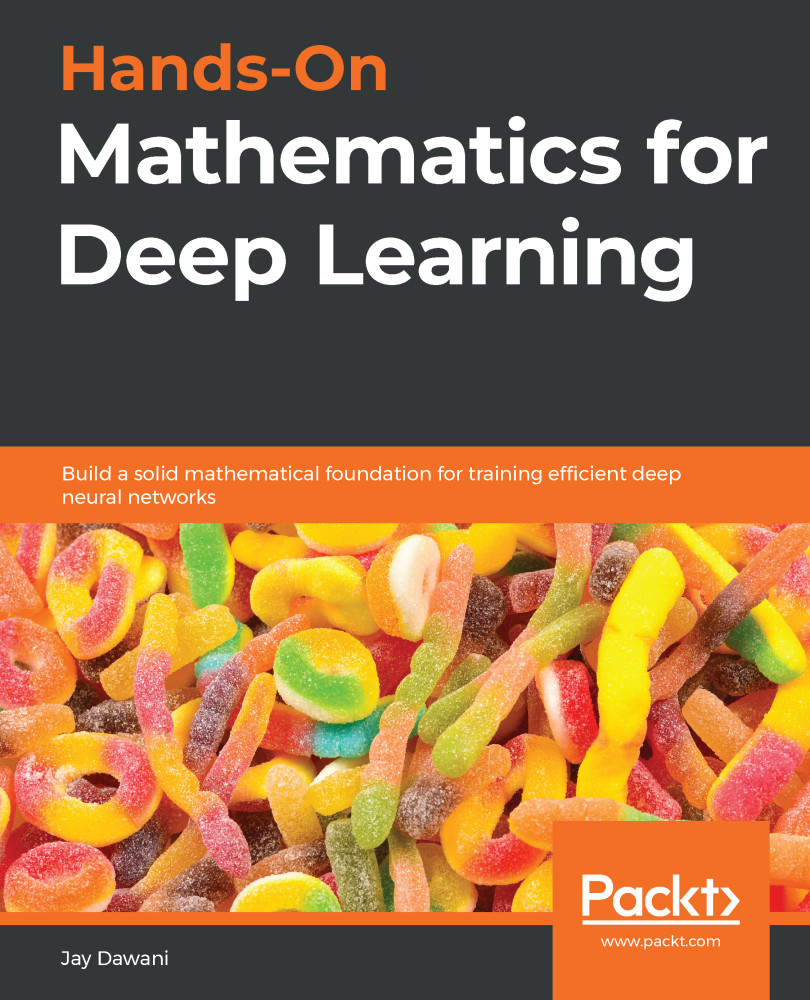
Most programmers and data scientists struggle with mathematics, having either overlooked or forgotten core mathematical concepts. This book uses Python libraries to help you understand the math required to build deep learning (DL) models. You'll begin by learning about core mathematical and modern computational techniques used to design and implement DL algorithms. This book will cover essential topics, such as linear algebra, eigenvalues and eigenvectors, the singular value decomposition concept, and gradient algorithms, to help you understand how to train deep neural networks. Later chapters focus on important neural networks, such as the linear neural network and multilayer perceptrons, with a primary focus on helping you learn how each model works. As you advance, you will delve into the math used for regularization, multi-layered DL, forward propagation, optimization, and backpropagation techniques to understand what it takes to build full-fledged DL models. Finally, you’ll explore CNN, recurrent neural network (RNN), and GAN models and their application. By the end of this book, you'll have built a strong foundation in neural networks and DL mathematical concepts, which will help you to confidently research and build custom models in DL.
Table of Contents (19 chapters)
close
close
1
Section 1: Essential Mathematics for Deep Learning
7
Section 2: Essential Neural Networks
13
Section 3: Advanced Deep Learning Concepts Simplified

The need for regularization

In previous chapters, we learned how feedforward neural networks are basically a complex function that maps an input to a corresponding target/label by learning the underlying distribution using the training data. We can recall that during training, after an error has been calculated during the forward pass, backpropagation is used to update the parameters in order to reduce the loss and better approximate the data distribution. We also learned about the capacity of neural networks, the bias-variance trade-off, and how neural networks can underfit or overfit to the training data, which prevents it from being able to perform well on unseen data or test data (that is, a generalization error occurs).

Before we get into what exactly regularization is, let's revisit overfitting and underfitting. Neural networks, as we know, are universal function approximators...

CONTINUE READING
83
Tech Concepts
36
Programming languages
73
Tech Tools
Icon Unlimited access to the largest independent learning library in tech of over 8,000 expert-authored tech books and videos.
Icon Innovative learning tools, including AI book assistants, code context explainers, and text-to-speech.
Icon 50+ new titles added per month and exclusive early access to books as they are being written.
Hands-On Mathematics for Deep Learning
notes
bookmark Notes and Bookmarks search Search in title playlist Add to playlist font-size Font size

Change the font size

margin-width Margin width

Change margin width

day-mode Day/Sepia/Night Modes

Change background colour

Close icon Search
Country selected

Close icon Your notes and bookmarks

Confirmation

Modal Close icon
claim successful

Buy this book with your credits?

Modal Close icon
Are you sure you want to buy this book with one of your credits?
Close
YES, BUY

Submit Your Feedback

Modal Close icon
Modal Close icon
Modal Close icon