Sign In Start Free Trial
Account

Add to playlist

Create a Playlist

Modal Close icon
You need to login to use this feature.
  • Book Overview & Buying Learning Java by Building Android Games
  • Table Of Contents Toc
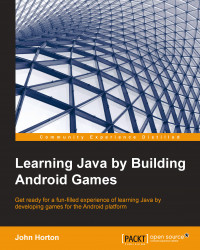
Learning Java by Building Android Games

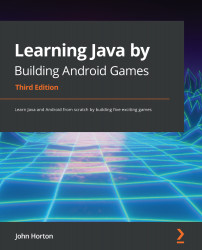
Learning Java by Building Android Games - Third Edition

By : John Horton
4 (13)
close
close
Learning Java by Building Android Games

Learning Java by Building Android Games

4 (13)
By: John Horton

Overview of this book

Android is one of the most popular mobile operating systems today. It uses the most popular programming language, Java, as one of the primary languages for building apps of all types. Unlike most other Android books, this book doesn’t assume that you have any prior knowledge of Java programming, instead helps you get started with building Android games as a beginner. This new, improved, and updated third edition of Learning Java by Building Android Games helps you to build Android games from scratch. Once you've got to grips with the fundamentals, the difficulty level increases steadily as you explore key Java topics, such as variables, loops, methods, object-oriented programming (OOP), and design patterns while working with up-to-date code and supporting examples. At each stage, you'll be able to test your understanding by implementing the concepts that you’ve learned to develop a game. Toward the end, you’ll build games such as Sub Hunter, Retro Pong, Bullet Hell, Classic Snake, and Scrolling Shooter. By the end of this Java book, you'll not only have a solid understanding of Java and Android basics but will also have developed five cool games for the Android platform.
Table of Contents (24 chapters)
close
close

Combining different control flow blocks

As you might have been able to guess, we can combine any of the decision-making tools such as if, else, and switch within our while loops, and the rest of the loops too. Take a look at the following example:

int x = 0;
int tooBig = 10;
while(true){
     x++; // I am going to get mighty big!
     if(x == tooBig){
          break;
     } // No you're not
     
     // code reaches here only until x = 10
}

It would be simple to go on for many more pages demonstrating the versatility of control flow structures, but at some point, we want to get back to finishing the game.

Now that we are confident with if and else, let's have a look at one more concept to do with loops.

Using the continue keyword

The continue keyword acts in a similar way to break,...

CONTINUE READING
83
Tech Concepts
36
Programming languages
73
Tech Tools
Icon Unlimited access to the largest independent learning library in tech of over 8,000 expert-authored tech books and videos.
Icon Innovative learning tools, including AI book assistants, code context explainers, and text-to-speech.
Icon 50+ new titles added per month and exclusive early access to books as they are being written.
Learning Java by Building Android Games
notes
bookmark Notes and Bookmarks search Search in title playlist Add to playlist download Download options font-size Font size

Change the font size

margin-width Margin width

Change margin width

day-mode Day/Sepia/Night Modes

Change background colour

Close icon Search
Country selected

Close icon Your notes and bookmarks

Confirmation

Modal Close icon
claim successful

Buy this book with your credits?

Modal Close icon
Are you sure you want to buy this book with one of your credits?
Close
YES, BUY

Submit Your Feedback

Modal Close icon
Modal Close icon
Modal Close icon