


-
Book Overview & Buying
-
Table Of Contents

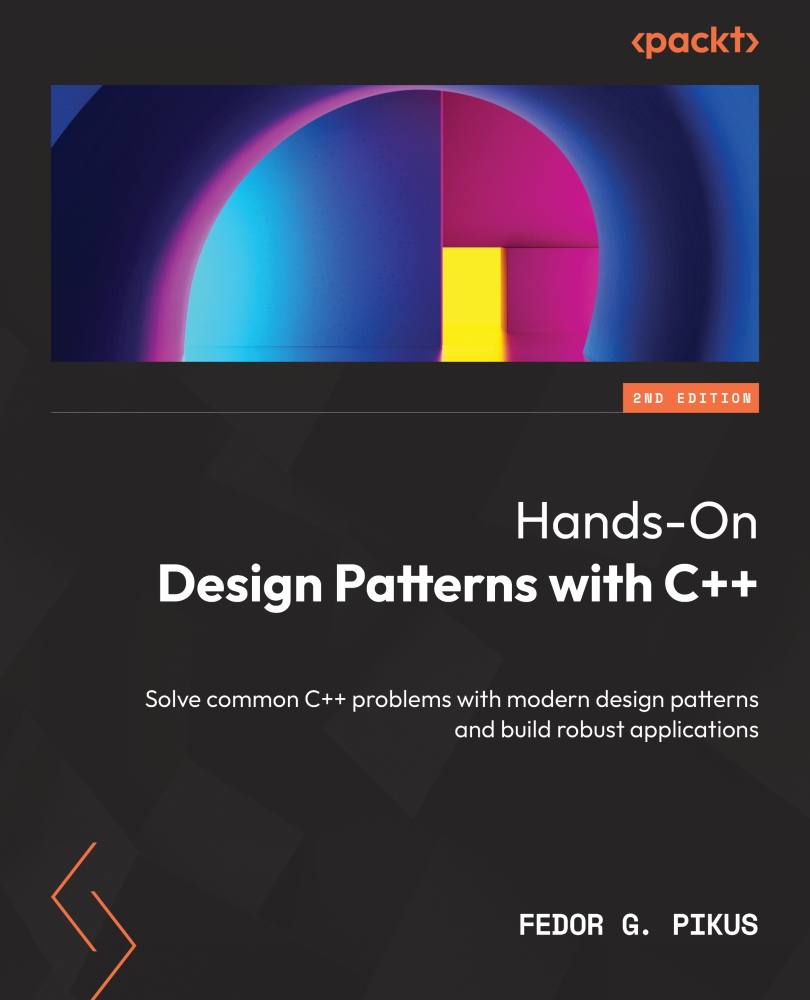
Hands-On Design Patterns with C++ - Second Edition
By :


Hands-On Design Patterns with C++
By:
Overview of this book
C++ is a general-purpose programming language designed for efficiency, performance, and flexibility. Design patterns are commonly accepted solutions to well-recognized design problems. In essence, they are a library of reusable components, only for software architecture, and not for a concrete implementation.
This book helps you focus on the design patterns that naturally adapt to your needs, and on the patterns that uniquely benefit from the features of C++. Armed with the knowledge of these patterns, you’ll spend less time searching for solutions to common problems and tackle challenges with the solutions developed from experience. You’ll also explore that design patterns are a concise and efficient way to communicate, as patterns are a familiar and recognizable solution to a specific problem and can convey a considerable amount of information with a single line of code.
By the end of this book, you’ll have a deep understanding of how to use design patterns to write maintainable, robust, and reusable software.
Table of Contents (26 chapters)
Preface


Part 1: Getting Started with C++ Features and Concepts
 Free Chapter
Chapter 1: An Introduction to Inheritance and Polymorphism
Chapter 2: Class and Function Templates
Chapter 3: Memory and Ownership
Part 2: Common C++ Idioms
Chapter 4: Swap – from Simple to Subtle
Chapter 5: A Comprehensive Look at RAII
Chapter 6: Understanding Type Erasure
Chapter 7: SFINAE, Concepts, and Overload Resolution Management
Part 3: C++ Design Patterns
Chapter 8: The Curiously Recurring Template Pattern
Chapter 9: Named Arguments, Method Chaining, and the Builder Pattern
Chapter 10: Local Buffer Optimization
Chapter 11: ScopeGuard
Chapter 12: Friend Factory

Chapter 13: Virtual Constructors and Factories
Chapter 14: The Template Method Pattern and the Non-Virtual Idiom
Part 4: Advanced C++ Design Patterns
Chapter 15: Policy-Based Design
Chapter 16: Adapters and Decorators
Chapter 17: The Visitor Pattern and Multiple Dispatch
Chapter 18: Patterns for Concurrency
Assessments
Index


