


-
Book Overview & Buying
-
Table Of Contents

Practical Business Process Modeling and Analysis
By :


Practical Business Process Modeling and Analysis
By:
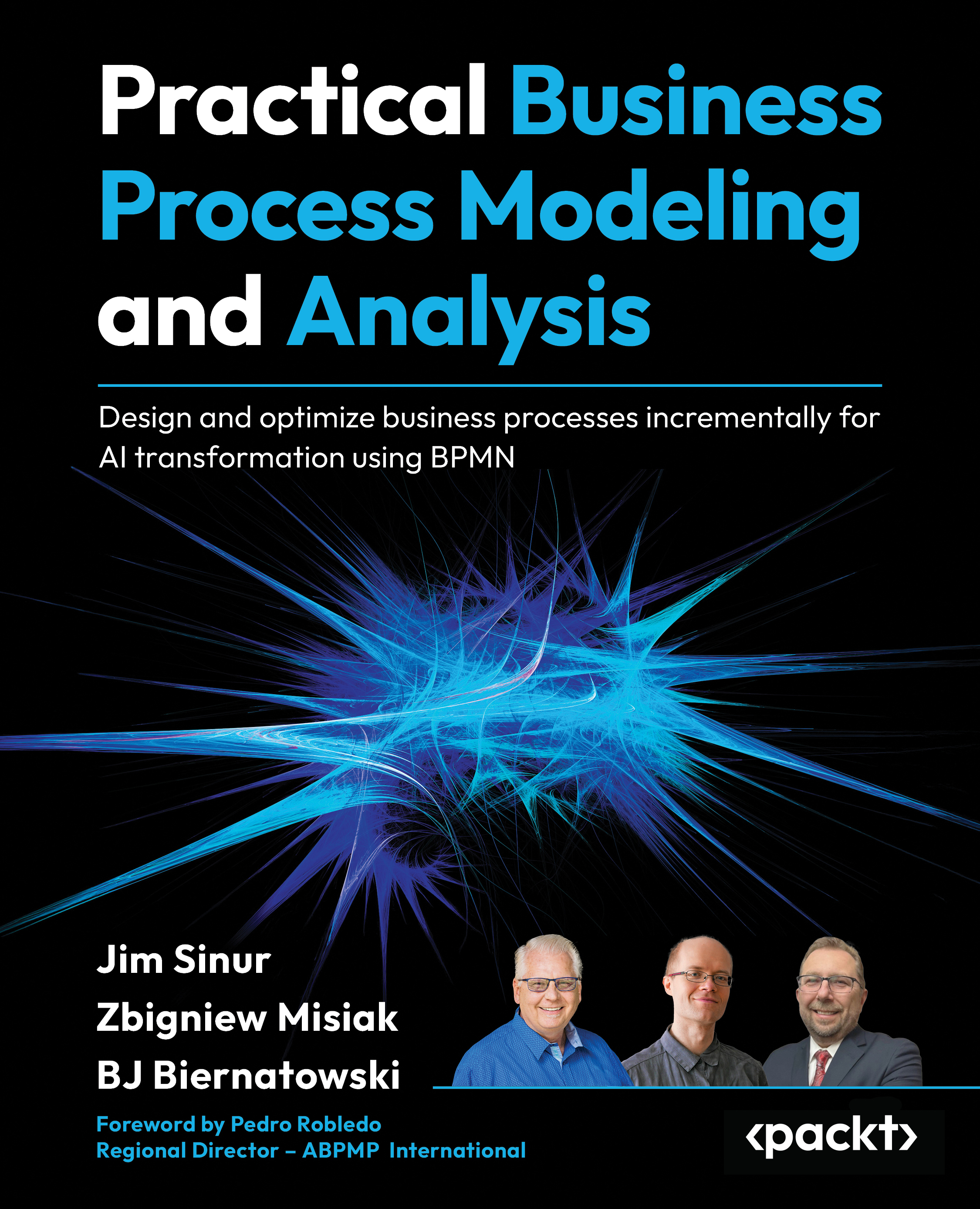
Overview of this book
Every business transformation begins with one question, “How can we do this better?” Whether it’s eliminating inefficiencies, optimizing business operations, or reimagining entire workflows with the help of AI, success depends on understanding and optimizing business processes. However, finding the right approach can be challenging with shifting market demands and evolving technologies.
In this book, three seasoned experts in BPM, automation, and AI-driven process optimization guide you through frameworks, techniques, and tools that drive digital transformation by helping you explore business process modelling, before and after process execution. You'll visualize complex workflows, establish scalable process architectures that drive digital transformation, and integrate automation for efficiency. With insights into BPMN, business value analysis, and field-tested consulting guidance, you'll see how process-led design and data-driven decisions can lead to smarter, more agile operations. Through real-world examples, you’ll grasp how leading organizations have optimized their processes and how you can apply the same principles in your digital change program.
By the end of this book, you’ll be able to identify, design, analyze, and transform business processes for measurable impact, as well as master the synergy of technology, process, and strategy to build systems that drive sustainable growth.
*Email sign-up and proof of purchase required
Table of Contents (14 chapters)
Preface


 Free Chapter
Winning at Digital Transformation with Process Modeling

Pillars of a Successful Digital Transformation
The Wheel of BPM Driving Your Competitive Advantage
Long-Term Trends and the Impact on Your Job
Business Process 101
Establishing Process Architecture
Process Modeling Notations
BPMN – What You Need to Know
Advanced BPMN
Measuring the Business Value of Process Transformation
A Few Final Thoughts
Index
Other Books You May Enjoy


