Sign In Start Free Trial
Account

Add to playlist

Create a Playlist

Modal Close icon
You need to login to use this feature.
  • Book Overview & Buying The C++ Workshop
  • Table Of Contents Toc
  • Feedback & Rating feedback
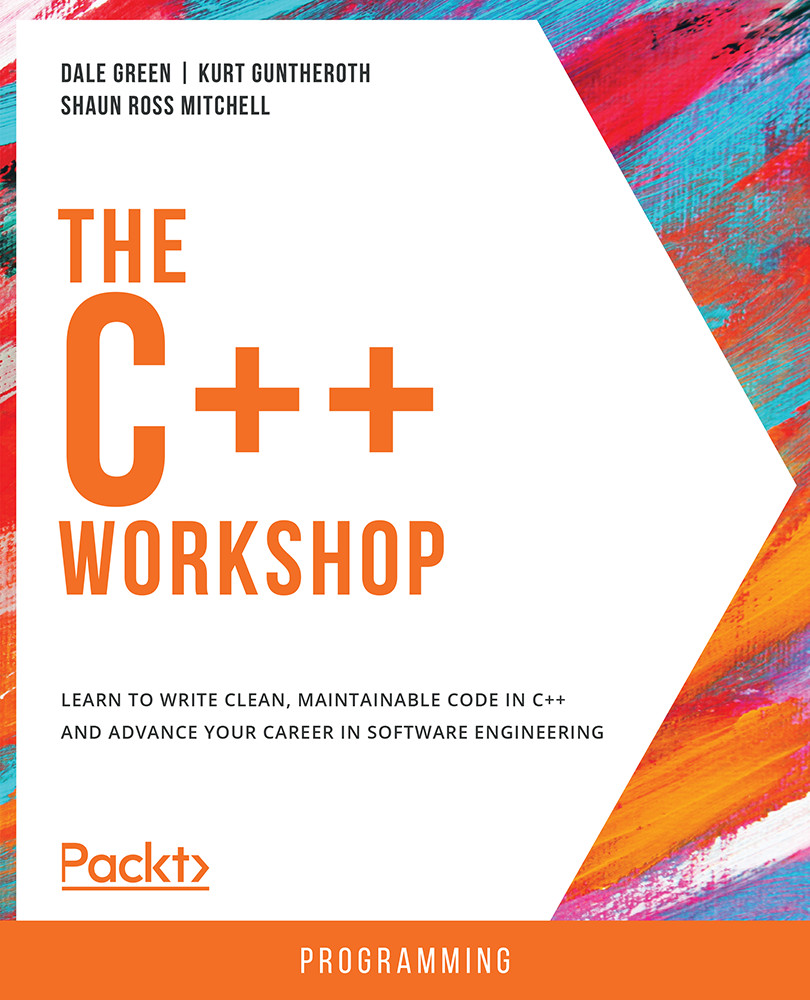
The C++ Workshop

The C++ Workshop

By : Dale Green , Kurt Guntheroth , Shaun Ross Mitchell
5 (8)
close
close
The C++ Workshop

The C++ Workshop

5 (8)
By: Dale Green , Kurt Guntheroth , Shaun Ross Mitchell

Overview of this book

C++ is the backbone of many games, GUI-based applications, and operating systems. Learning C++ effectively is more than a matter of simply reading through theory, as the real challenge is understanding the fundamentals in depth and being able to use them in the real world. If you're looking to learn C++ programming efficiently, this Workshop is a comprehensive guide that covers all the core features of C++ and how to apply them. It will help you take the next big step toward writing efficient, reliable C++ programs. The C++ Workshop begins by explaining the basic structure of a C++ application, showing you how to write and run your first program to understand data types, operators, variables and the flow of control structures. You'll also see how to make smarter decisions when it comes to using storage space by declaring dynamic variables during program runtime. Moving ahead, you'll use object-oriented programming (OOP) techniques such as inheritance, polymorphism, and class hierarchies to make your code structure organized and efficient. Finally, you'll use the C++ standard library?s built-in functions and templates to speed up different programming tasks. By the end of this C++ book, you will have the knowledge and skills to confidently tackle your own ambitious projects and advance your career as a C++ developer.
Table of Contents (15 chapters)
close
close

if/else

One of the most basic, yet most important, control flow statements is if. This simple keyword is at the heart of all logic, allowing us to perform a given action only if a specified condition is true. By chaining these if statements together in creative ways, we can model any logical system.

The syntax for an if statement is as follows:

    if (condition) { // do stuff. }

If the statement we use as our condition resolves to true, then the code within the curly braces will be executed. If the statement is false, then it will be skipped. Our condition can be anything that can be either true or false. This can be something simple, such as checking the value of a Boolean, or something more complex, such as the result of another operation or function.

We also have the else statement. This allows code to be executed if, and only if, a preceding if statement's condition evaluates to false. If the condition evaluates to true, however, and the if...

Visually different images
CONTINUE READING
83
Tech Concepts
36
Programming languages
73
Tech Tools
Icon Unlimited access to the largest independent learning library in tech of over 8,000 expert-authored tech books and videos.
Icon Innovative learning tools, including AI book assistants, code context explainers, and text-to-speech.
Icon 50+ new titles added per month and exclusive early access to books as they are being written.
The C++ Workshop
notes
bookmark Notes and Bookmarks search Search in title playlist Add to playlist download Download options font-size Font size

Change the font size

margin-width Margin width

Change margin width

day-mode Day/Sepia/Night Modes

Change background colour

Close icon Search
Country selected

Close icon Your notes and bookmarks

Confirmation

Modal Close icon
claim successful

Buy this book with your credits?

Modal Close icon
Are you sure you want to buy this book with one of your credits?
Close
YES, BUY

Submit Your Feedback

Modal Close icon
Modal Close icon
Modal Close icon