Sign In Start Free Trial
Account

Add to playlist

Create a Playlist

Modal Close icon
You need to login to use this feature.
  • Book Overview & Buying Unity 2022 Mobile Game Development
  • Table Of Contents Toc
Unity 2022 Mobile Game Development

Unity 2022 Mobile Game Development - Third Edition

By : John P. Doran
5 (10)
close
close
Unity 2022 Mobile Game Development

Unity 2022 Mobile Game Development

5 (10)
By: John P. Doran

Overview of this book

Unity is a well-established player in the mobile game development sphere, and its new release, Unity 2022, is packed with new, exciting features. In Unity 2022 Mobile Game Development, Third Edition, you'll get to grips with the Unity game engine by building a mobile game and publishing it on the most popular mobile app stores as well as exploring the all-new features. This book provides a comprehensive and practical approach to mobile game development, helping you build an endless runner game. Starting with setting up a simple Unity project for mobile development, you’ll delve into various essential aspects needed to successfully create and publish your game. You’ll acquire a range of skills, such as incorporating touch gestures, monetizing your game with Unity Ads and in-app purchases, designing an intuitive UI, and seamlessly integrating social media functionalities. Additionally, you’ll gain valuable insights into player preferences and behavior using Unity's analytics tools. You’ll also explore features of augmented reality in Unity 2022, enhancing your game's appeal. By the end of this book, you’ll be well-equipped to reap the power of Unity 2022 to build, optimize, and publish robust cross-platform mobile games with C#, as well as widening your skill set and enhancing your credentials as a game developer.
Table of Contents (21 chapters)
close
close
1
Part 1: Gameplay/Development Setup
4
Part 2: Mobile-Specific Features
11
Part 3: Game Feel/Polish

Creating the player

To get started, we’ll build a player that will always move forward. Let’s start with that now:

  1. To get started, we will create some ground for our player to walk on. To do that, go to the top menu and select GameObject | 3D Object | Cube.
  2. From there, we’ll move over to the Inspector window and change the name of the object to Floor. Then, for the Transform component, set Position to (0, 0, 0). This can be done by either typing the values in or right-clicking on the Transform component and then selecting the Reset Position option.
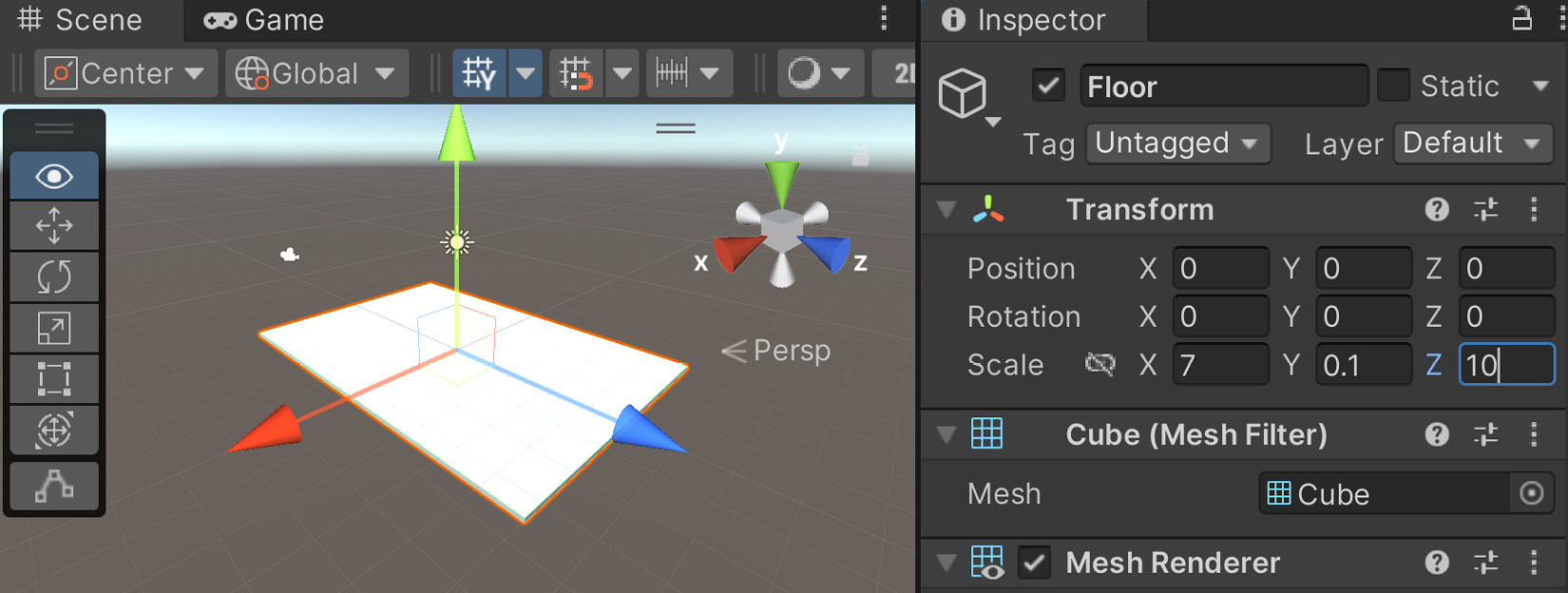
  3. Then, we will set the Scale values of the object to (7, 0.1, 10):
Figure 1.4 – Creating the ground

Figure 1.4 – Creating the ground

In Unity, by default, 1 unit of space is representative of 1 meter in real life. So, our Scale values will make the floor longer than it is wide (X and Z), and we have some size on the ground (Y), so the player will collide and land on it because we have a Box Collider component attached to it by default.

Note

The Box Collider component is added automatically when creating a Cube object and is required to have objects collide with it. For more information on the Box Collider component, check out https://docs.unity3d.com/Manual/class-BoxCollider.html.

  1. Next, we will create our player, which will be a sphere. To do this, we will go to GameObject | 3D Object | Sphere.
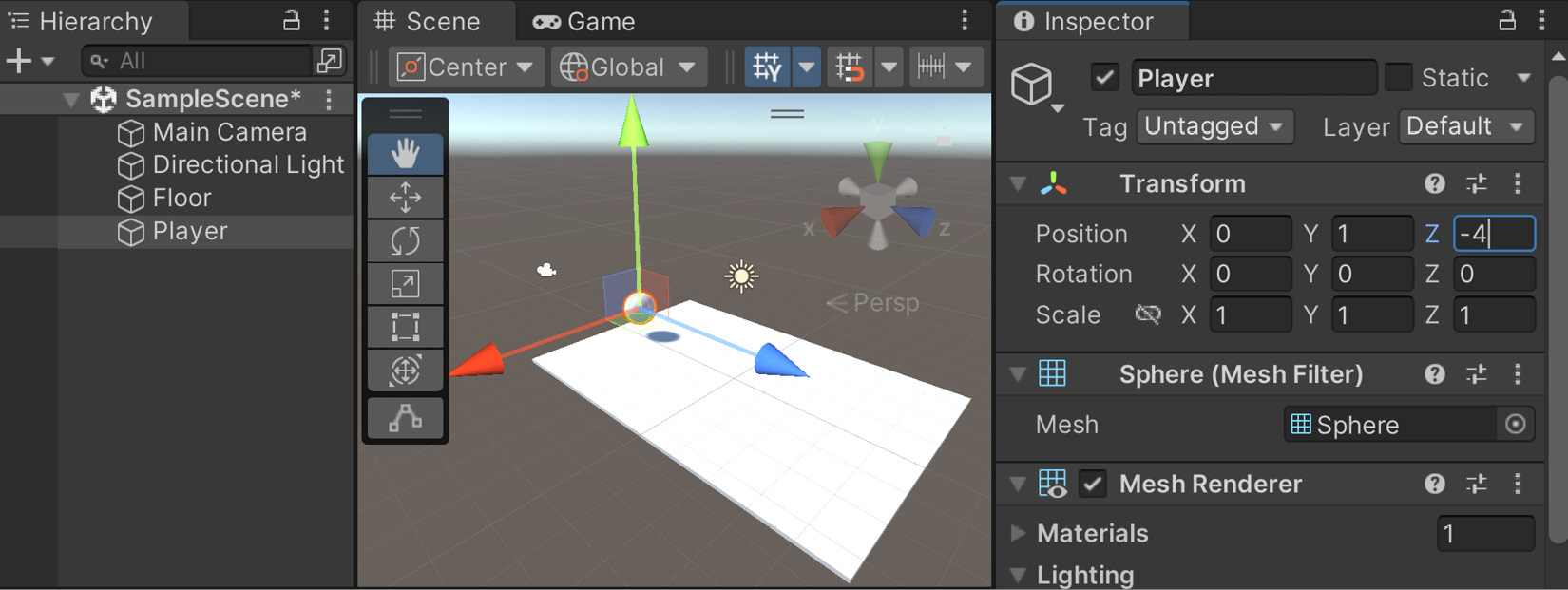
  2. Rename the sphere to Player and set the Transform component’s Position values to (0, 1, -4):
Figure 1.5 – Positioning the player

Figure 1.5 – Positioning the player

This places the ball slightly above the ground and shifts it back to near the starting point. Note that the camera object (see the camera icon) is pointing toward the ball by default because it is positioned at (0, 1, -10).

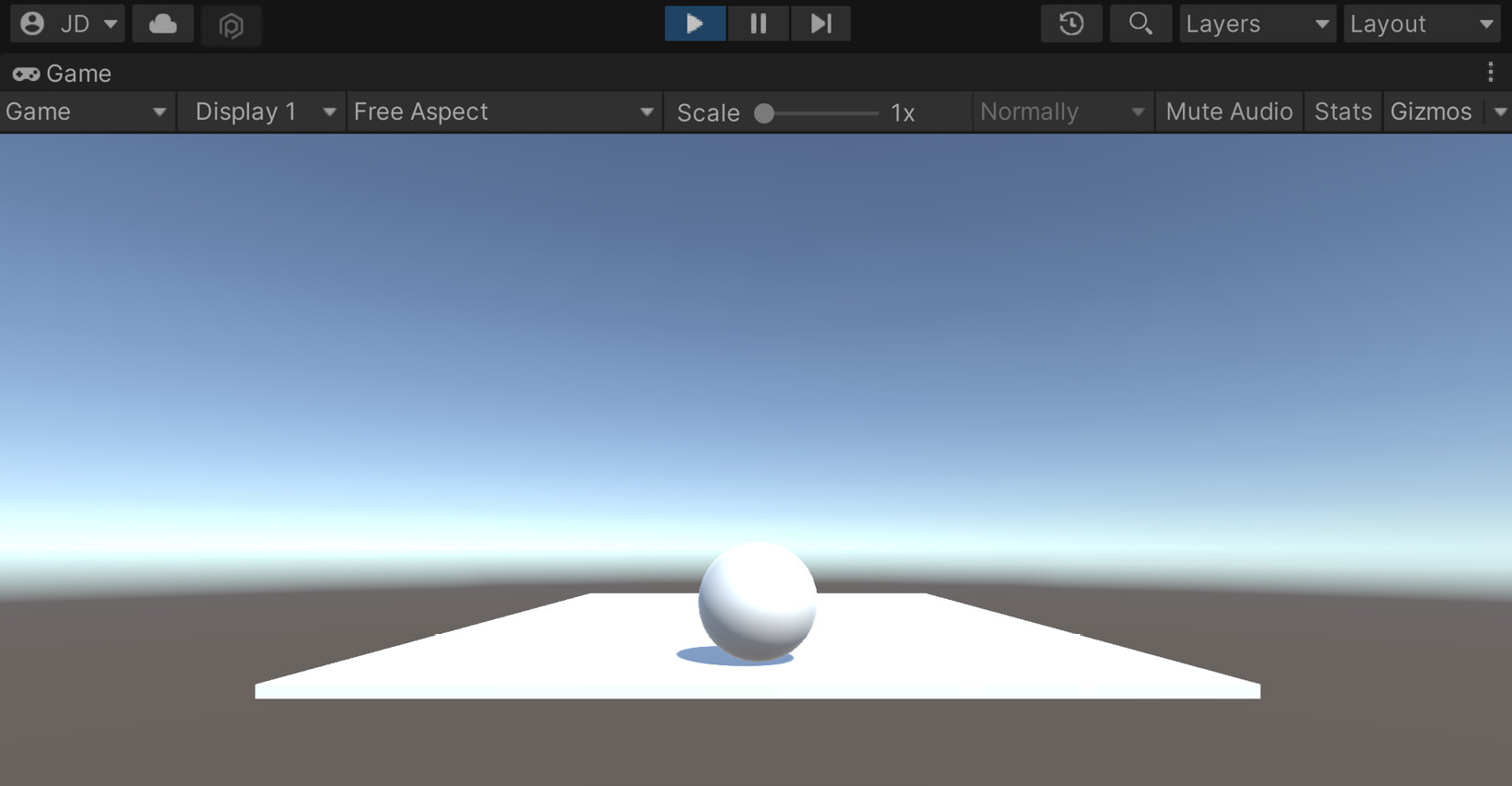
  1. We want the ball to move, so we will need to tell the physics engine that we want to have this object react to forces, so we will need to add a Rigidbody component. To do so, with the Player object selected, go to the menu and select Component | Physics | Rigidbody. To see what happens now, let’s click on the Play button, which can be seen in the middle of the first toolbar:
Figure 1.6 – Current state of the game

Figure 1.6 – Current state of the game

As in the preceding screenshot, you should see the ball fall down onto the ground when we play the game.

Tip

You can disable/enable having the Game tab take up the entire screen when being played by clicking on the Maximize On Play button at the top, or by right-clicking on the Game tab and then selecting Maximize.

  1. Click on the Play button again to turn the game off and go back to the Scene tab, if it doesn’t happen automatically.

We now have the objects for both the floor and the player in the game and have told the player to react to physics! Next, we will add interactivity to the player through the use of code.

CONTINUE READING
83
Tech Concepts
36
Programming languages
73
Tech Tools
Icon Unlimited access to the largest independent learning library in tech of over 8,000 expert-authored tech books and videos.
Icon Innovative learning tools, including AI book assistants, code context explainers, and text-to-speech.
Icon 50+ new titles added per month and exclusive early access to books as they are being written.
Unity 2022 Mobile Game Development
notes
bookmark Notes and Bookmarks search Search in title playlist Add to playlist download Download options font-size Font size

Change the font size

margin-width Margin width

Change margin width

day-mode Day/Sepia/Night Modes

Change background colour

Close icon Search
Country selected

Close icon Your notes and bookmarks

Confirmation

Modal Close icon
claim successful

Buy this book with your credits?

Modal Close icon
Are you sure you want to buy this book with one of your credits?
Close
YES, BUY

Submit Your Feedback

Modal Close icon
Modal Close icon
Modal Close icon