
Sign In Start Free Trial
Account

Add to playlist

Create a Playlist

Modal Close icon
You need to login to use this feature.
  • Book Overview & Buying Hands-On Deep Learning for Games
  • Table Of Contents Toc
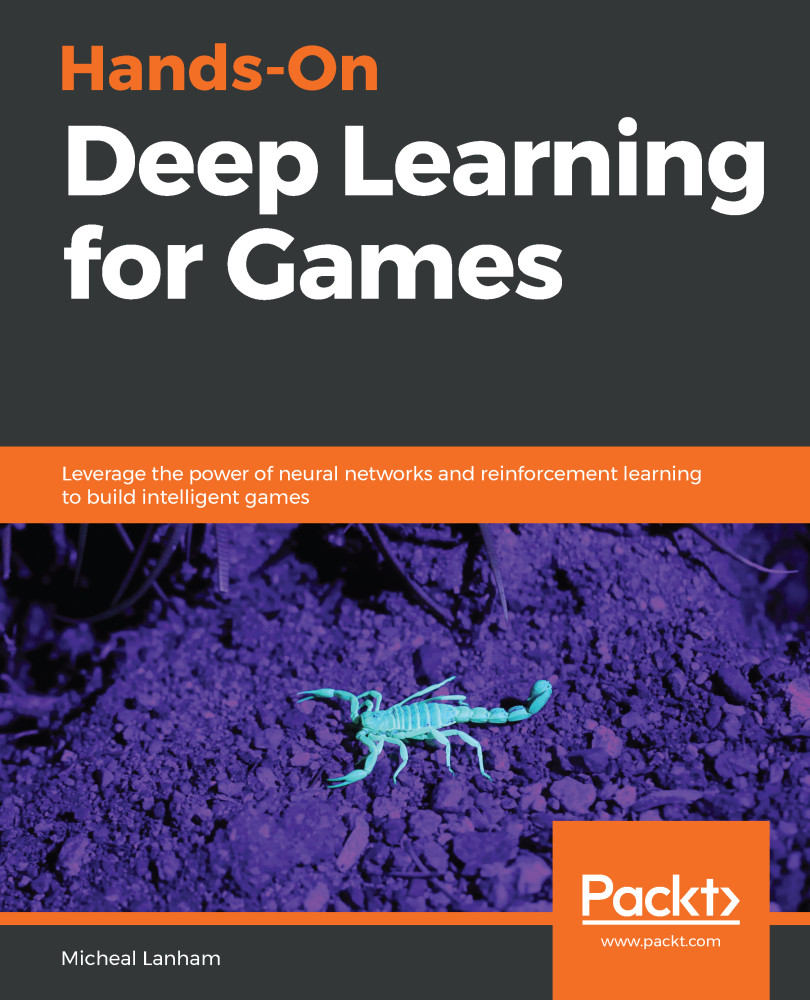
Hands-On Deep Learning for Games

Hands-On Deep Learning for Games

By : Micheal Lanham
3 (2)
close
close
Hands-On Deep Learning for Games

Hands-On Deep Learning for Games

3 (2)
By: Micheal Lanham

Overview of this book

The number of applications of deep learning and neural networks has multiplied in the last couple of years. Neural nets has enabled significant breakthroughs in everything from computer vision, voice generation, voice recognition and self-driving cars. Game development is also a key area where these techniques are being applied. This book will give an in depth view of the potential of deep learning and neural networks in game development. We will take a look at the foundations of multi-layer perceptron’s to using convolutional and recurrent networks. In applications from GANs that create music or textures to self-driving cars and chatbots. Then we introduce deep reinforcement learning through the multi-armed bandit problem and other OpenAI Gym environments. As we progress through the book we will gain insights about DRL techniques such as Motivated Reinforcement Learning with Curiosity and Curriculum Learning. We also take a closer look at deep reinforcement learning and in particular the Unity ML-Agents toolkit. By the end of the book, we will look at how to apply DRL and the ML-Agents toolkit to enhance, test and automate your games or simulations. Finally, we will cover your possible next steps and possible areas for future learning.
Table of Contents (18 chapters)
close
close
Lock Free Chapter
1
Section 1: The Basics
6
Section 2: Deep Reinforcement Learning
14
Section 3: Building Games

GAN for Games

Thus far, in our deep learning exploration, we have trained all our networks using a technique called supervised training. This training technique works well for when you have taken the time to identify and label your data. All of our previous example exercises used supervised training, because it is the simplest form of teaching. However, supervised learning tends to be the most cumbersome and tedious method, largely because it requires some amount of data labeling or identification before training. There have been attempts to use this form of training for machine learning or deep learning in gaming and simulation, but they have proven to be unsuccessful.

This is why, for most of this book, we will look at other forms of training, starting with a form of unsupervised training called a generative adversarial network (GAN). GANs are able to train themselves using...

Visually different images
CONTINUE READING
83
Tech Concepts
36
Programming languages
73
Tech Tools
Icon Unlimited access to the largest independent learning library in tech of over 8,000 expert-authored tech books and videos.
Icon Innovative learning tools, including AI book assistants, code context explainers, and text-to-speech.
Icon 50+ new titles added per month and exclusive early access to books as they are being written.
Hands-On Deep Learning for Games
notes
bookmark Notes and Bookmarks search Search in title playlist Add to playlist download Download options font-size Font size

Change the font size

margin-width Margin width

Change margin width

day-mode Day/Sepia/Night Modes

Change background colour

Close icon Search
Country selected

Close icon Your notes and bookmarks

Confirmation

Modal Close icon
claim successful

Buy this book with your credits?

Modal Close icon
Are you sure you want to buy this book with one of your credits?
Close
YES, BUY

Submit Your Feedback

Modal Close icon
Modal Close icon
Modal Close icon