


-
Book Overview & Buying
-
Table Of Contents

Build Your Own Programming Language
By :


Build Your Own Programming Language
By:
Overview of this book
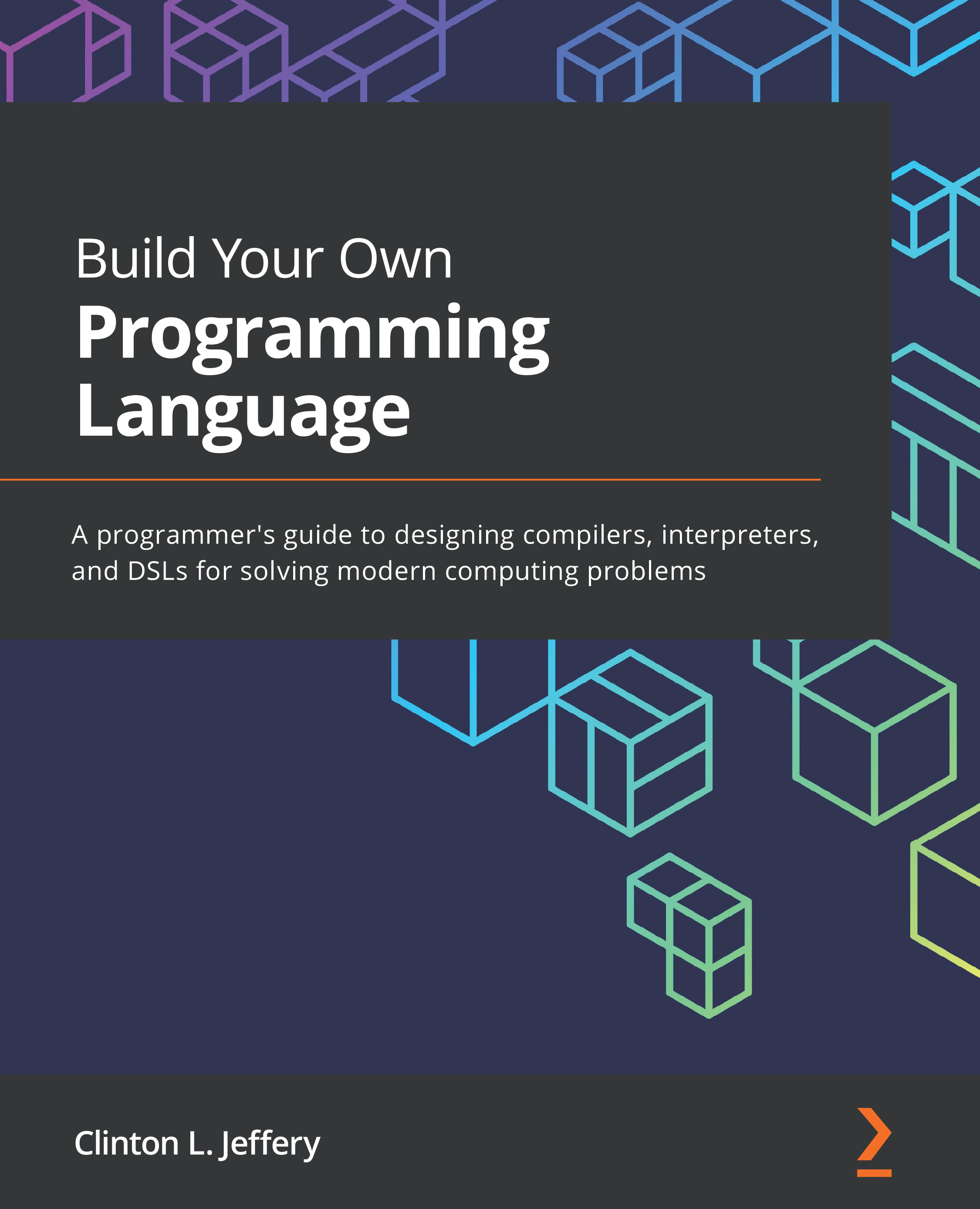
The need for different types of computer languages is growing rapidly and developers prefer creating domain-specific languages for solving specific application domain problems. Building your own programming language has its advantages. It can be your antidote to the ever-increasing size and complexity of software.
In this book, you’ll start with implementing the frontend of a compiler for your language, including a lexical analyzer and parser. The book covers a series of traversals of syntax trees, culminating with code generation for a bytecode virtual machine. Moving ahead, you’ll learn how domain-specific language features are often best represented by operators and functions that are built into the language, rather than library functions. We’ll conclude with how to implement garbage collection, including reference counting and mark-and-sweep garbage collection. Throughout the book, Dr. Jeffery weaves in his experience of building the Unicon programming language to give better context to the concepts where relevant examples are provided in both Unicon and Java so that you can follow the code of your choice of either a very high-level language with advanced features, or a mainstream language.
By the end of this book, you’ll be able to build and deploy your own domain-specific languages, capable of compiling and running programs.
Table of Contents (25 chapters)
Preface


Section 1: Programming Language Frontends
 Free Chapter
Chapter 1: Why Build Another Programming Language?
Chapter 2: Programming Language Design
Chapter 3: Scanning Source Code
Chapter 4: Parsing
Chapter 5: Syntax Trees
Section 2: Syntax Tree Traversals
Chapter 6: Symbol Tables
Chapter 7: Checking Base Types
Chapter 8: Checking Types on Arrays, Method Calls, and Structure Accesses
Chapter 9: Intermediate Code Generation
Chapter 10: Syntax Coloring in an IDE
Section 3: Code Generation and Runtime Systems
Chapter 11: Bytecode Interpreters

Chapter 12: Generating Bytecode
Chapter 13: Native Code Generation
Chapter 14: Implementing Operators and Built-In Functions
Chapter 15: Domain Control Structures
Chapter 16: Garbage Collection
Chapter 17: Final Thoughts
Section 4: Appendix
Assessments
Other Books You May Enjoy


