
Sign In Start Free Trial
Account

Add to playlist

Create a Playlist

Modal Close icon
You need to login to use this feature.
  • Book Overview & Buying Learn Kotlin Programming
  • Table Of Contents Toc
Learn Kotlin Programming

Learn Kotlin Programming - Second Edition

By : Samuel, Bocutiu
close
close
Learn Kotlin Programming

Learn Kotlin Programming

By: Samuel, Bocutiu

Overview of this book

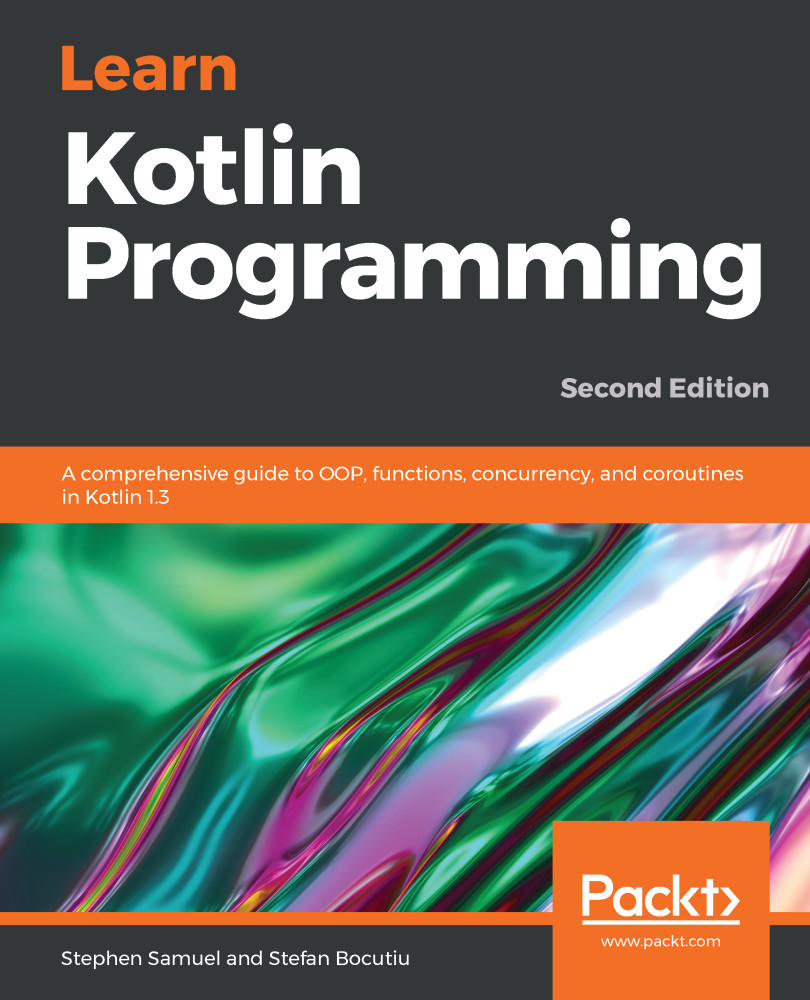
Kotlin is a general-purpose programming language used for developing cross-platform applications. Complete with a comprehensive introduction and projects covering the full set of Kotlin programming features, this book will take you through the fundamentals of Kotlin and get you up to speed in no time. Learn Kotlin Programming covers the installation, tools, and how to write basic programs in Kotlin. You'll learn how to implement object-oriented programming in Kotlin and easily reuse your program or parts of it. The book explains DSL construction, serialization, null safety aspects, and type parameterization to help you build robust apps. You'll learn how to destructure expressions and write your own. You'll then get to grips with building scalable apps by exploring advanced topics such as testing, concurrency, microservices, coroutines, and Kotlin DSL builders. Furthermore, you'll be introduced to the kotlinx.serialization framework, which is used to persist objects in JSON, Protobuf, and other formats. By the end of this book, you'll be well versed with all the new features in Kotlin and will be able to build robust applications skillfully.
Table of Contents (21 chapters)
close
close
Lock Free Chapter
1
Section 1: Fundamental Concepts in Kotlin
5
Section 2: Practical Concepts in Kotlin
15
Section 3: Advanced Concepts in Kotlin

Reflection

Reflection is the name given to inspecting code at runtime instead of compile time. It can be used to create instances of classes, look up functions and invoke them, inspect annotations, find fields, and discover parameters and generics, all without knowing those details at compile time.

For example, we might want to persist types into a database, but we don't know, or don't want to have to know, in advance which types will be persisted. Reflection could be used to look up the fields of each type, creating the appropriate SQL code for each type.

Another example would be if we had a plugin system in our code, and at runtime we wanted to create instances of the plugin based on config or system properties. We could use reflection to instantiate classes based on the fully qualified name passed in.

For the rest of this chapter, we will cover the various reflection...

CONTINUE READING
83
Tech Concepts
36
Programming languages
73
Tech Tools
Icon Unlimited access to the largest independent learning library in tech of over 8,000 expert-authored tech books and videos.
Icon Innovative learning tools, including AI book assistants, code context explainers, and text-to-speech.
Icon 50+ new titles added per month and exclusive early access to books as they are being written.
Learn Kotlin Programming
notes
bookmark Notes and Bookmarks search Search in title playlist Add to playlist download Download options font-size Font size

Change the font size

margin-width Margin width

Change margin width

day-mode Day/Sepia/Night Modes

Change background colour

Close icon Search
Country selected

Close icon Your notes and bookmarks

Confirmation

Modal Close icon
claim successful

Buy this book with your credits?

Modal Close icon
Are you sure you want to buy this book with one of your credits?
Close
YES, BUY

Submit Your Feedback

Modal Close icon
Modal Close icon
Modal Close icon