Sign In Start Free Trial
Account

Add to playlist

Create a Playlist

Modal Close icon
You need to login to use this feature.
  • Book Overview & Buying Practical System Programming for Rust Developers
  • Table Of Contents Toc
Practical System Programming for Rust Developers

Practical System Programming for Rust Developers

By : Eshwarla
4.6 (5)
close
close
Practical System Programming for Rust Developers

Practical System Programming for Rust Developers

4.6 (5)
By: Eshwarla

Overview of this book

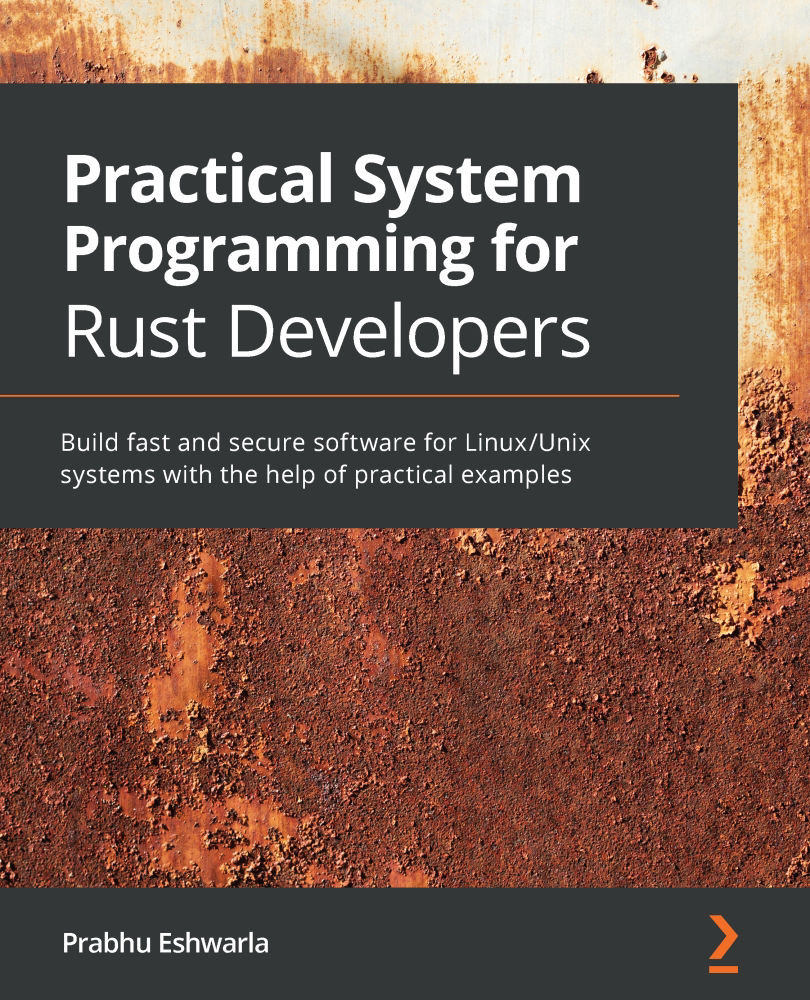
Modern programming languages such as Python, JavaScript, and Java have become increasingly accepted for application-level programming, but for systems programming, C and C++ are predominantly used due to the need for low-level control of system resources. Rust promises the best of both worlds: the type safety of Java, and the speed and expressiveness of C++, while also including memory safety without a garbage collector. This book is a comprehensive introduction if you’re new to Rust and systems programming and are looking to build reliable and efficient systems software without C or C++. The book takes a unique approach by starting each topic with Linux kernel concepts and APIs relevant to that topic. You’ll also explore how system resources can be controlled from Rust. As you progress, you’ll delve into advanced topics. You’ll cover network programming, focusing on aspects such as working with low-level network primitives and protocols in Rust, before going on to learn how to use and compile Rust with WebAssembly. Later chapters will take you through practical code examples and projects to help you build on your knowledge. By the end of this Rust programming book, you will be equipped with practical skills to write systems software tools, libraries, and utilities in Rust.
Table of Contents (17 chapters)
close
close
1
Section 1: Getting Started with System Programming in Rust
6
Section 2: Managing and Controlling System Resources in Rust
12
Section 3: Advanced Topics

Preface

The modern software stack is evolving rapidly in size and complexity. Technology domains such as the cloud, the web, data science, machine learning, DevOps, containers, IoT, embedded systems, distributed ledgers, virtual and augmented reality, and artificial intelligence continue to evolve and specialize. This has resulted in a severe shortage of system software developers able to build out the system infrastructure components. Modern societies, businesses, and governments increasingly rely heavily on digital technologies, which puts greater emphasis on developing safe, reliable, and efficient systems software and software infrastructure that modern web and mobile applications are built on.

System programming languages such as C/C++ have proved their mettle for decades in this domain, and provide a high degree of control and performance, but it is at the cost of memory safety.

Higher-level languages such as Java, C#, Python, Ruby, and JavaScript provide memory safety but offer less control over memory layout, and suffer from garbage collection pauses.

Rust is a modern, open source system programming language that promises the best of three worlds: the type safety of Java; the speed, expressiveness, and efficiency of C++; and memory safety without a garbage collector.

This book adopts a unique three-step approach to teaching system programming in Rust. Each chapter in this book starts with an overview of the system programming fundamentals and kernel system calls for that topic in Unix-like operating systems (Unix/Linux/macOS). You will then learn how to perform common system calls using the Rust Standard Library, and in a few cases, external crates, using abundant code snippets. This knowledge is then reinforced through a practical example project that you will build. Lastly, there are questions in each chapter to embed learning.

By the end of this book, you will have a sound foundational understanding of how to use Rust to manage and control operating system resources such as memory, files, processes, threads, system environment, peripheral devices, networking interfaces, terminals, and shells, and you'll understand how to build cross-language bindings through FFI. Along the way, you will learn how to use the tools of the trade, and get a firm appreciation of the value Rust brings to build safe, performant, reliable, and efficient system-level software.

CONTINUE READING
83
Tech Concepts
36
Programming languages
73
Tech Tools
Icon Unlimited access to the largest independent learning library in tech of over 8,000 expert-authored tech books and videos.
Icon Innovative learning tools, including AI book assistants, code context explainers, and text-to-speech.
Icon 50+ new titles added per month and exclusive early access to books as they are being written.
Practical System Programming for Rust Developers
notes
bookmark Notes and Bookmarks search Search in title playlist Add to playlist download Download options font-size Font size

Change the font size

margin-width Margin width

Change margin width

day-mode Day/Sepia/Night Modes

Change background colour

Close icon Search
Country selected

Close icon Your notes and bookmarks

Confirmation

Modal Close icon
claim successful

Buy this book with your credits?

Modal Close icon
Are you sure you want to buy this book with one of your credits?
Close
YES, BUY

Submit Your Feedback

Modal Close icon
Modal Close icon
Modal Close icon