Sign In Start Free Trial
Account

Add to playlist

Create a Playlist

Modal Close icon
You need to login to use this feature.
  • Book Overview & Buying Python Object-Oriented Programming
  • Table Of Contents Toc
  • Feedback & Rating feedback
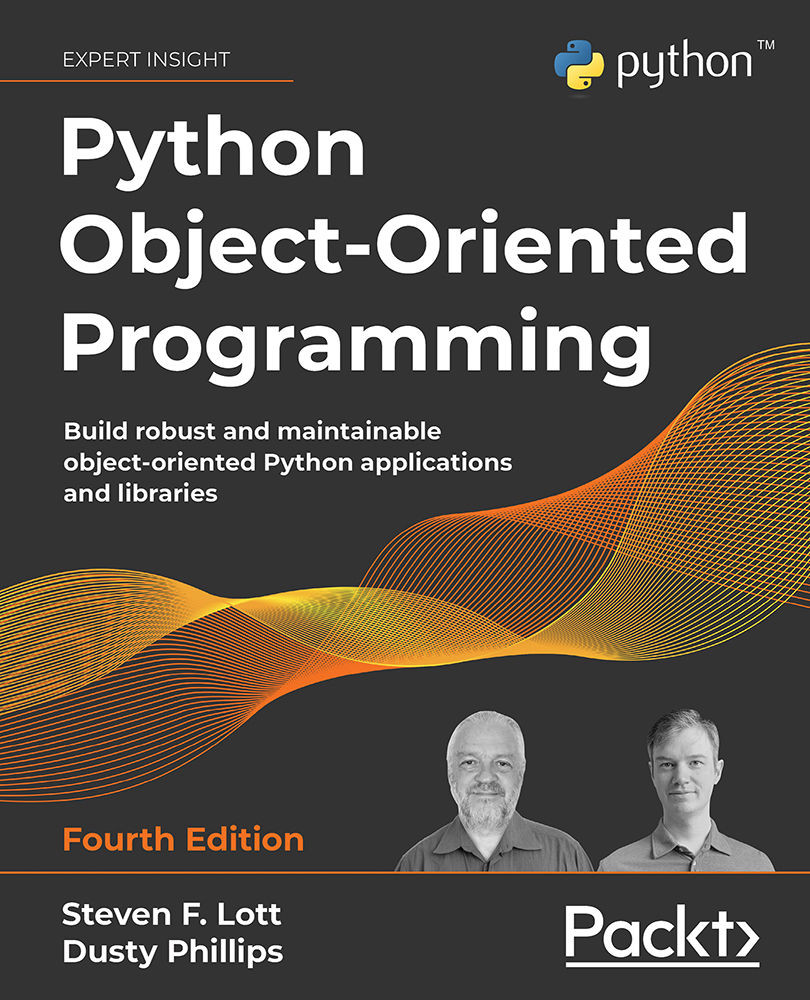
Python Object-Oriented Programming

Python Object-Oriented Programming - Fourth Edition

By : Steven F. Lott, Dusty Phillips
3.9 (34)
close
close
Python Object-Oriented Programming

Python Object-Oriented Programming

3.9 (34)
By: Steven F. Lott, Dusty Phillips

Overview of this book

Object-oriented programming (OOP) is a popular design paradigm in which data and behaviors are encapsulated in such a way that they can be manipulated together. Python Object-Oriented Programming, Fourth Edition dives deep into the various aspects of OOP, Python as an OOP language, common and advanced design patterns, and hands-on data manipulation and testing of more complex OOP systems. These concepts are consolidated by open-ended exercises, as well as a real-world case study at the end of every chapter, newly written for this edition. All example code is now compatible with Python 3.9+ syntax and has been updated with type hints for ease of learning. Steven and Dusty provide a comprehensive, illustrative tour of important OOP concepts, such as inheritance, composition, and polymorphism, and explain how they work together with Python’s classes and data structures to facilitate good design. In addition, the book also features an in-depth look at Python’s exception handling and how functional programming intersects with OOP. Two very powerful automated testing systems, unittest and pytest, are introduced. The final chapter provides a detailed discussion of Python's concurrent programming ecosystem. By the end of the book, you will have a thorough understanding of how to think about and apply object-oriented principles using Python syntax and be able to confidently create robust and reliable programs.
Table of Contents (17 chapters)
close
close
15
Other Books You May Enjoy
16
Index

File I/O

Our examples so far that have touched the filesystem have operated entirely on text files without much thought as to what is going on under the hood. Operating systems represent files as a sequence of bytes, not text. We'll take a deep dive into the relationship between bytes and text in Chapter 9Strings, Serialization, and File Paths. For now, be aware that reading textual data from a file is a fairly involved process, but Python takes care of most of the work for us behind the scenes.

The concept of files has been around since long before anyone coined the term object-oriented programming. However, Python has wrapped the interface that operating systems provide in a sweet abstraction that allows us to work with file (or file-like, vis-à-vis duck typing) objects.

The confusion arises because the operating system file and the Python file object are both, commonly, called "files." It's difficult to be ultra-cautious and...

Visually different images
CONTINUE READING
83
Tech Concepts
36
Programming languages
73
Tech Tools
Icon Unlimited access to the largest independent learning library in tech of over 8,000 expert-authored tech books and videos.
Icon Innovative learning tools, including AI book assistants, code context explainers, and text-to-speech.
Icon 50+ new titles added per month and exclusive early access to books as they are being written.
Python Object-Oriented Programming
notes
bookmark Notes and Bookmarks search Search in title playlist Add to playlist download Download options font-size Font size

Change the font size

margin-width Margin width

Change margin width

day-mode Day/Sepia/Night Modes

Change background colour

Close icon Search
Country selected

Close icon Your notes and bookmarks

Confirmation

Modal Close icon
claim successful

Buy this book with your credits?

Modal Close icon
Are you sure you want to buy this book with one of your credits?
Close
YES, BUY

Submit Your Feedback

Modal Close icon
Modal Close icon
Modal Close icon