
Sign In Start Free Trial
Account

Add to playlist

Create a Playlist

Modal Close icon
You need to login to use this feature.
  • Book Overview & Buying Applying Math with Python
  • Table Of Contents Toc
  • Feedback & Rating feedback
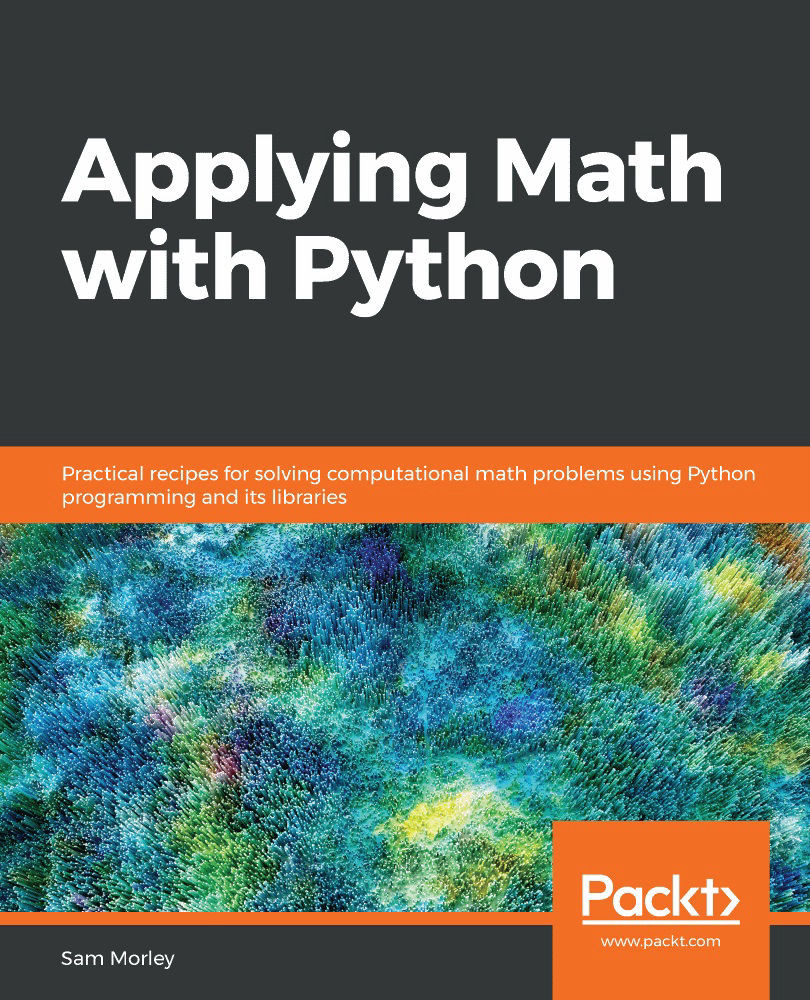
Applying Math with Python

Applying Math with Python

By : Sam Morley
4.3 (4)
close
close
Applying Math with Python

Applying Math with Python

4.3 (4)
By: Sam Morley

Overview of this book

Python, one of the world's most popular programming languages, has a number of powerful packages to help you tackle complex mathematical problems in a simple and efficient way. These core capabilities help programmers pave the way for building exciting applications in various domains, such as machine learning and data science, using knowledge in the computational mathematics domain. The book teaches you how to solve problems faced in a wide variety of mathematical fields, including calculus, probability, statistics and data science, graph theory, optimization, and geometry. You'll start by developing core skills and learning about packages covered in Python’s scientific stack, including NumPy, SciPy, and Matplotlib. As you advance, you'll get to grips with more advanced topics of calculus, probability, and networks (graph theory). After you gain a solid understanding of these topics, you'll discover Python's applications in data science and statistics, forecasting, geometry, and optimization. The final chapters will take you through a collection of miscellaneous problems, including working with specific data formats and accelerating code. By the end of this book, you'll have an arsenal of practical coding solutions that can be used and modified to solve a wide range of practical problems in computational mathematics and data science.
Table of Contents (12 chapters)
close
close
Working with Trees and Networks

Networks are objects that contain nodesand edges between pairs of nodes. They can be used to represent a wide variety of real-world situations, such as distribution and scheduling. Mathematically, networks are useful for visualizing combinatorial problems and make for a rich and fascinating theory.

There are, of course, several different kinds of networks. We will mostly deal with simple networks, where edges connect two distinct nodes (so there are no self-loops), there is, at most, one edge between any two nodes, and all the edges are bidirectional. A treeis a special kind of network in which there are no cycles; that is, there are no lists of nodes in which each node is connected to the following node by an edge, and the final node is connected to the first. Trees are especially simple in terms of their theory because they connect a number of nodes with the fewest possible edges. A complete...

Visually different images
CONTINUE READING
83
Tech Concepts
36
Programming languages
73
Tech Tools
Icon Unlimited access to the largest independent learning library in tech of over 8,000 expert-authored tech books and videos.
Icon Innovative learning tools, including AI book assistants, code context explainers, and text-to-speech.
Icon 50+ new titles added per month and exclusive early access to books as they are being written.
Applying Math with Python
notes
bookmark Notes and Bookmarks search Search in title playlist Add to playlist download Download options font-size Font size

Change the font size

margin-width Margin width

Change margin width

day-mode Day/Sepia/Night Modes

Change background colour

Close icon Search
Country selected

Close icon Your notes and bookmarks

Confirmation

Modal Close icon
claim successful

Buy this book with your credits?

Modal Close icon
Are you sure you want to buy this book with one of your credits?
Close
YES, BUY

Submit Your Feedback

Modal Close icon
Modal Close icon
Modal Close icon