
Sign In Start Free Trial
Account

Add to playlist

Create a Playlist

Modal Close icon
You need to login to use this feature.
  • Book Overview & Buying Unity Virtual Reality Projects
  • Table Of Contents Toc
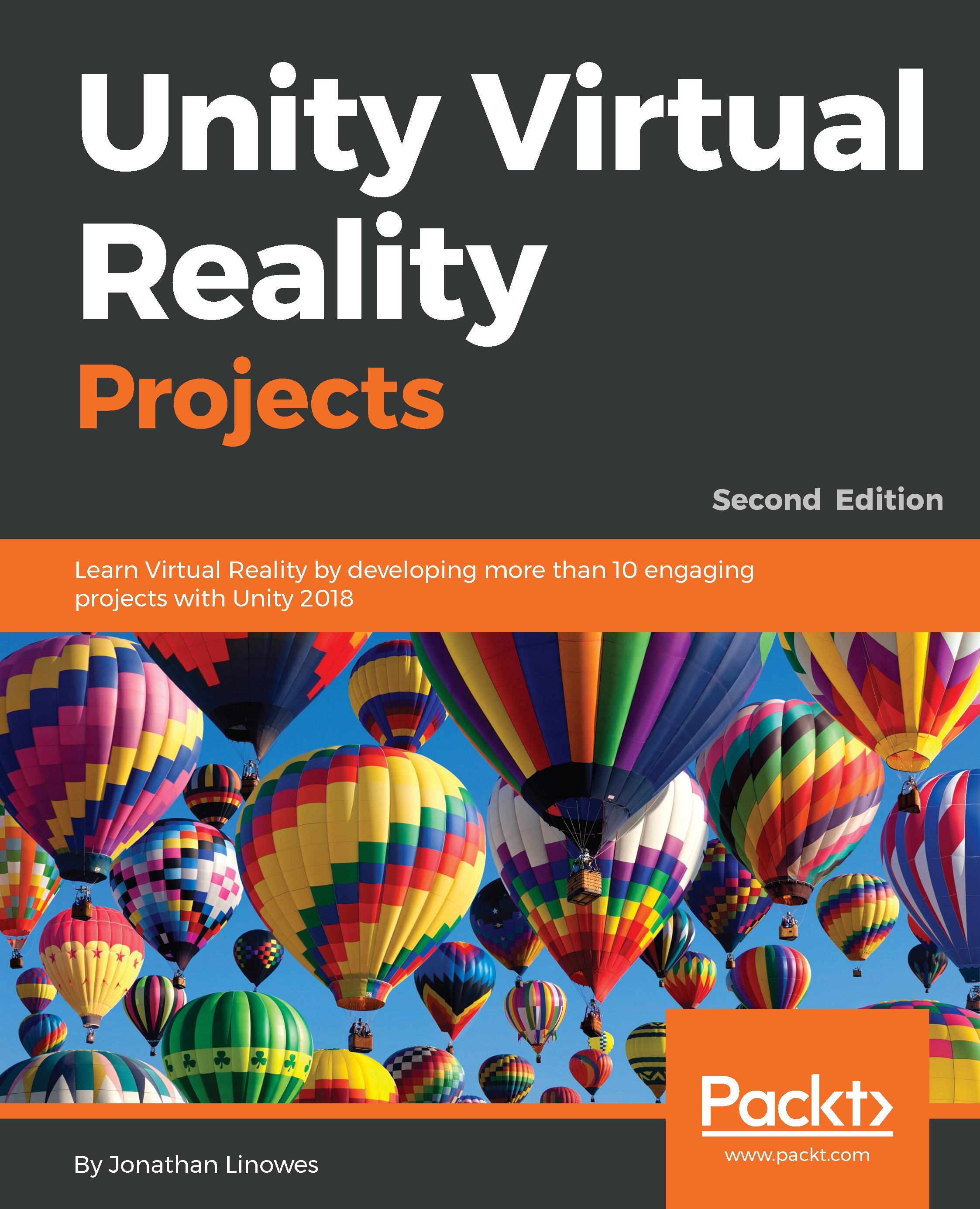
Unity Virtual Reality Projects

Unity Virtual Reality Projects - Second Edition

By : Jonathan Linowes
3.3 (4)
close
close
Unity Virtual Reality Projects

Unity Virtual Reality Projects

3.3 (4)
By: Jonathan Linowes

Overview of this book

Unity has become the leading platform for building virtual reality games, applications, and experiences for this new generation of consumer VR devices. Unity Virtual Reality Projects walks you through a series of hands-on tutorials and in-depth discussions on using the Unity game engine to develop VR applications. With its practical and project-based approach, this book will get you up to speed with the specifics of VR development in Unity. You will learn how to use Unity to develop VR applications that can be experienced with devices such as Oculus, Daydream, and Vive. Among the many topics and projects, you will explore gaze-based versus hand-controller input, world space UI canvases, locomotion and teleportation, software design patterns, 360-degree media, timeline animation, and multiplayer networking. You will learn about the Unity 3D game engine via the interactive Unity Editor, and you will also learn about C# programming. By the end of the book, you will be fully equipped to develop rich, interactive VR experiences using Unity.
Table of Contents (15 chapters)
close
close

World Space UI

In the previous chapter, we discovered how to interact with game objects in the world space scene. Not only can these objects can be balls and toys, or tools and weapons, but they can be buttons you interact with and other user interface widgets. Furthermore, Unity includes a user interface canvas system for building menus and other UI.

Graphical user interface (GUI) or just UI, usually refers to on-screen two-dimensional graphics, which overlay the main gameplay and present information to the user with status messages, gauges, and input controls such as menus, buttons, sliders, and so on.

In Unity, UI elements always reside on a canvas. The Unity manual describes the canvas component as follows:

The canvas component represents the abstract space in which the UI is laid out and rendered. All UI elements must be children of a GameObject that has a canvas component...
CONTINUE READING
83
Tech Concepts
36
Programming languages
73
Tech Tools
Icon Unlimited access to the largest independent learning library in tech of over 8,000 expert-authored tech books and videos.
Icon Innovative learning tools, including AI book assistants, code context explainers, and text-to-speech.
Icon 50+ new titles added per month and exclusive early access to books as they are being written.
Unity Virtual Reality Projects
notes
bookmark Notes and Bookmarks search Search in title playlist Add to playlist download Download options font-size Font size

Change the font size

margin-width Margin width

Change margin width

day-mode Day/Sepia/Night Modes

Change background colour

Close icon Search
Country selected

Close icon Your notes and bookmarks

Confirmation

Modal Close icon
claim successful

Buy this book with your credits?

Modal Close icon
Are you sure you want to buy this book with one of your credits?
Close
YES, BUY

Submit Your Feedback

Modal Close icon
Modal Close icon
Modal Close icon