
Sign In Start Free Trial
Account

Add to playlist

Create a Playlist

Modal Close icon
You need to login to use this feature.
  • Book Overview & Buying Learn C Programming
  • Table Of Contents Toc
  • Feedback & Rating feedback
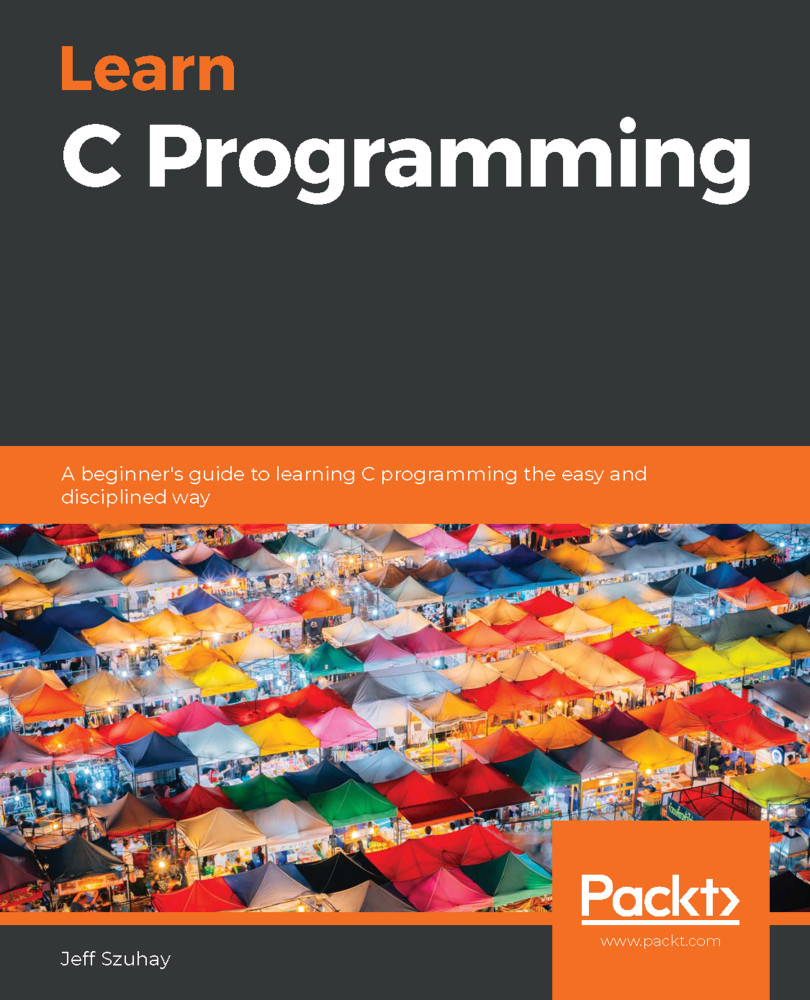
Learn C Programming

Learn C Programming

By : Jeff Szuhay
4.2 (16)
close
close
Learn C Programming

Learn C Programming

4.2 (16)
By: Jeff Szuhay

Overview of this book

C is a powerful general-purpose programming language that is excellent for beginners to learn. This book will introduce you to computer programming and software development using C. If you're an experienced developer, this book will help you to become familiar with the C programming language. This C programming book takes you through basic programming concepts and shows you how to implement them in C. Throughout the book, you'll create and run programs that make use of one or more C concepts, such as program structure with functions, data types, and conditional statements. You'll also see how to use looping and iteration, arrays, pointers, and strings. As you make progress, you'll cover code documentation, testing and validation methods, basic input/output, and how to write complete programs in C. By the end of the book, you'll have developed basic programming skills in C, that you can apply to other programming languages and will develop a solid foundation for you to advance as a programmer.
Table of Contents (33 chapters)
close
close
1
Section 1: C Fundamentals
10
Section 2: Complex Data Types
19
Section 3: Memory Manipulation
22
Section 4: Input and Output
28
Section 5: Building Blocks for Larger Programs

Reading string and character input with scanf()

One way to read a string is to use scanf() with the %s specifier. We will also see some other ways of doing this later in this chapter. The %s specifier assigns a sequence of non-whitespace characters to the given array. As with numbers, leading whitespace is skipped. Recall that whitespace can be ' ', '\t', '\n', '\r', '\f', or '\v'. Conversion stops on the first occurrence of whitespace after one or more instances of non-whitespace or at the maximum field width, if specified. Otherwise, the array to which the input string is assigned must be large enough to hold the string plus the terminating NUL character.

The following program demonstrates this effect:

#include <stdio.h>
const int bufferSize = 80;
int main( void ) {
char stringBuffer[ bufferSize ];

printf( "Enter a string: " );
scanf("%s" , stringBuffer );
printf( "Processed...

Visually different images
CONTINUE READING
83
Tech Concepts
36
Programming languages
73
Tech Tools
Icon Unlimited access to the largest independent learning library in tech of over 8,000 expert-authored tech books and videos.
Icon Innovative learning tools, including AI book assistants, code context explainers, and text-to-speech.
Icon 50+ new titles added per month and exclusive early access to books as they are being written.
Learn C Programming
notes
bookmark Notes and Bookmarks search Search in title playlist Add to playlist download Download options font-size Font size

Change the font size

margin-width Margin width

Change margin width

day-mode Day/Sepia/Night Modes

Change background colour

Close icon Search
Country selected

Close icon Your notes and bookmarks

Confirmation

Modal Close icon
claim successful

Buy this book with your credits?

Modal Close icon
Are you sure you want to buy this book with one of your credits?
Close
YES, BUY

Submit Your Feedback

Modal Close icon
Modal Close icon
Modal Close icon