
Sign In Start Free Trial
Account

Add to playlist

Create a Playlist

Modal Close icon
You need to login to use this feature.
  • Book Overview & Buying Hands-On Game Development without Coding
  • Table Of Contents Toc
Hands-On Game Development without Coding

Hands-On Game Development without Coding

By : Lucas Bertolini
2.3 (3)
close
close
Hands-On Game Development without Coding

Hands-On Game Development without Coding

2.3 (3)
By: Lucas Bertolini

Overview of this book

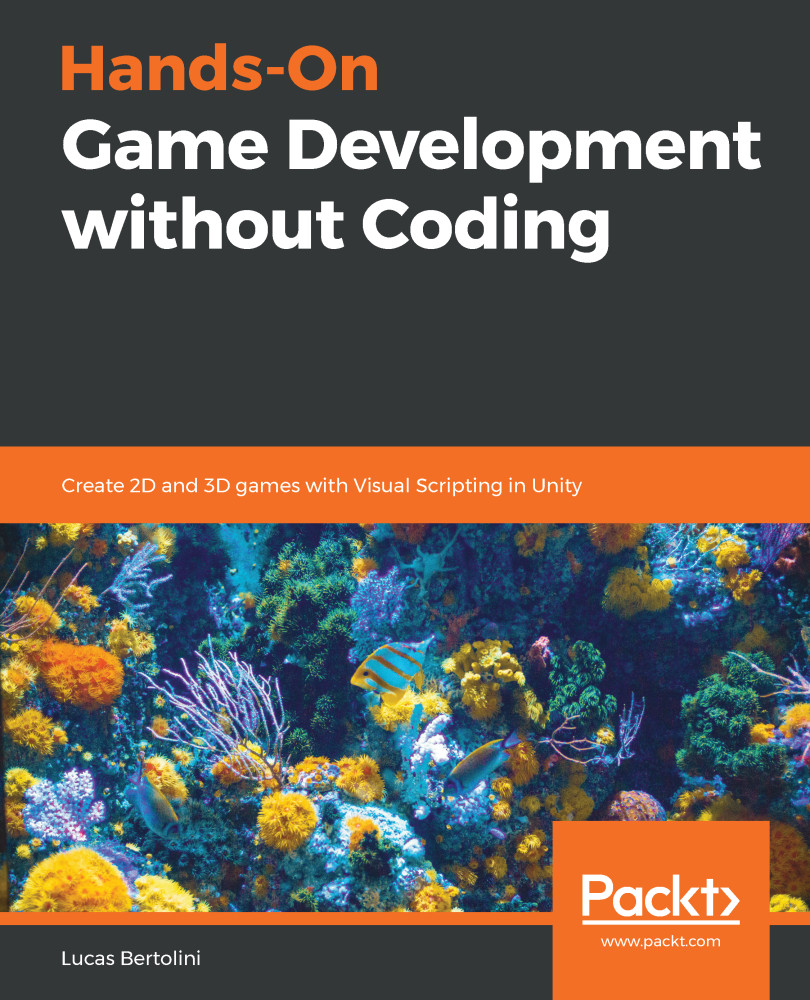
Hands-On Game Development without Coding is the first Visual Scripting book in the market. It was tailor made for a non programing audience who are wondering how a videogame is made. After reading this book you will be able to develop your own 2d and 3d videogames and use it on your presentations, to speed up your level design deliveries, test your game design ideas, work on your proofs of concept, or even doing it just for fun. The best thing about Hands-On Game Development without Coding is that you don’t need any previous knowledge to read and understand the process of creating a videogame. It is our main focus to provide you with the opportunity to create a videogame as easy and fast as possible. Once you go through the book, you will be able to create player input interaction, levels, object behaviours, enemy AI, creating your own UI and finally giving life to your game by building it. It’s Alive!
Table of Contents (16 chapters)
close
close
5
Object Behaviors - Adding Logic to Objects
7
Interactable Objects - Enhancing Interaction

Summary

I hope you found this chapter as interesting as I wanted it to be. This was our first contact with Unity, so the chapter focused on an introducing all the tools that the environment has.

There are many features in Unity, but as this is our handshake with this editor, we worked on the main aspects of it.

We learned that Unity works with GameObjects, which are placed in our digital world. These objects have different components and values, which give them certain behaviors.

We can use the windows in our layout to see everything that is happening in our project. The Scene view is where we can edit our GameObjects, which are also shown in the hierarchy. The Game view is the way the player will see the game, the Inspector is used to check the components and values of our objects, and the Project window is where we can add and delete assets.

Finally, we worked on the Splash...

CONTINUE READING
83
Tech Concepts
36
Programming languages
73
Tech Tools
Icon Unlimited access to the largest independent learning library in tech of over 8,000 expert-authored tech books and videos.
Icon Innovative learning tools, including AI book assistants, code context explainers, and text-to-speech.
Icon 50+ new titles added per month and exclusive early access to books as they are being written.
Hands-On Game Development without Coding
notes
bookmark Notes and Bookmarks search Search in title playlist Add to playlist download Download options font-size Font size

Change the font size

margin-width Margin width

Change margin width

day-mode Day/Sepia/Night Modes

Change background colour

Close icon Search
Country selected

Close icon Your notes and bookmarks

Confirmation

Modal Close icon
claim successful

Buy this book with your credits?

Modal Close icon
Are you sure you want to buy this book with one of your credits?
Close
YES, BUY

Submit Your Feedback

Modal Close icon
Modal Close icon
Modal Close icon